
We are happy that Marco Lutz, one of our external PhD candidates supervised by Tobias Ullmann, has published a new article in Scientific Reports, together with Daniel Heßdörfer, Tobias Ullmann and Melanie Brandmeier.
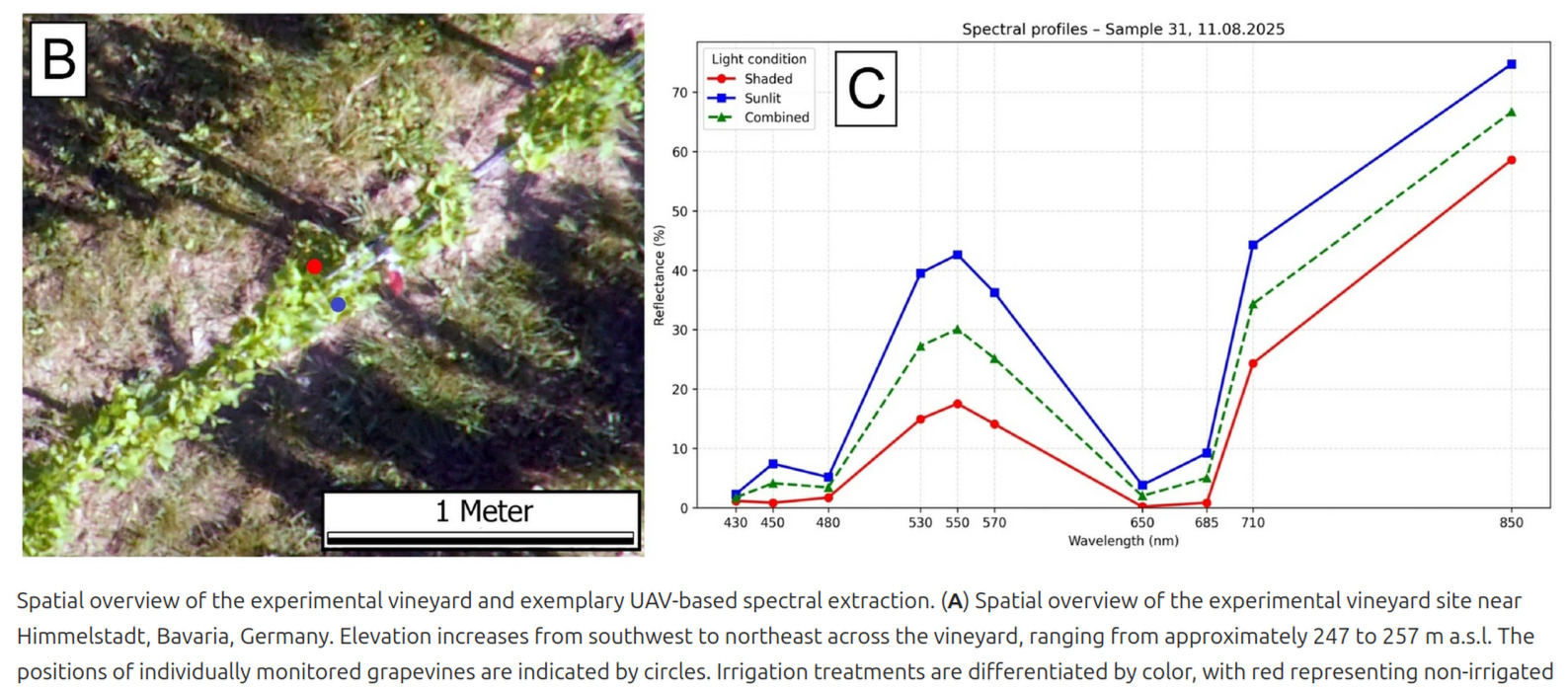
Measuring how well a grapevine photosynthesizes usually means clipping a chamber onto single leaves, which is accurate but slow. The study asks whether a machine-learning approach developed for leaf-level hyperspectral measurements can be transferred to multispectral UAV imagery, as a step towards scalable monitoring in precision viticulture. The team combined in situ measurements from 2024 and 2025 at an experimental vineyard near Himmelstadt with UAV flights from 2025.
The results are promising. UAV-based models reached R² values of up to 0.77 for net assimilation rate and electron transport rate and up to 0.90 for the effective quantum yield of photosystem II. Shaded and combined canopy pixels worked better than sunlit ones for the first two traits. Models also generalized to unseen vines, but not yet to unseen measurement dates, which the authors name as the key limitation and want to address with another season in 2026.
Lutz, M., Heßdörfer, D., Ullmann, T. & Brandmeier, M. (2026). Assessing the feasibility of up-scaling grapevine physiological trait estimation using multispectral UAV imagery. Scientific Reports 16, 33048. doi.org/10.1038/s41598-026-76877-z