
A Green Globe for Future Space Sensors

A Green Globe for Future Space Sensors

m

June 10, 2026

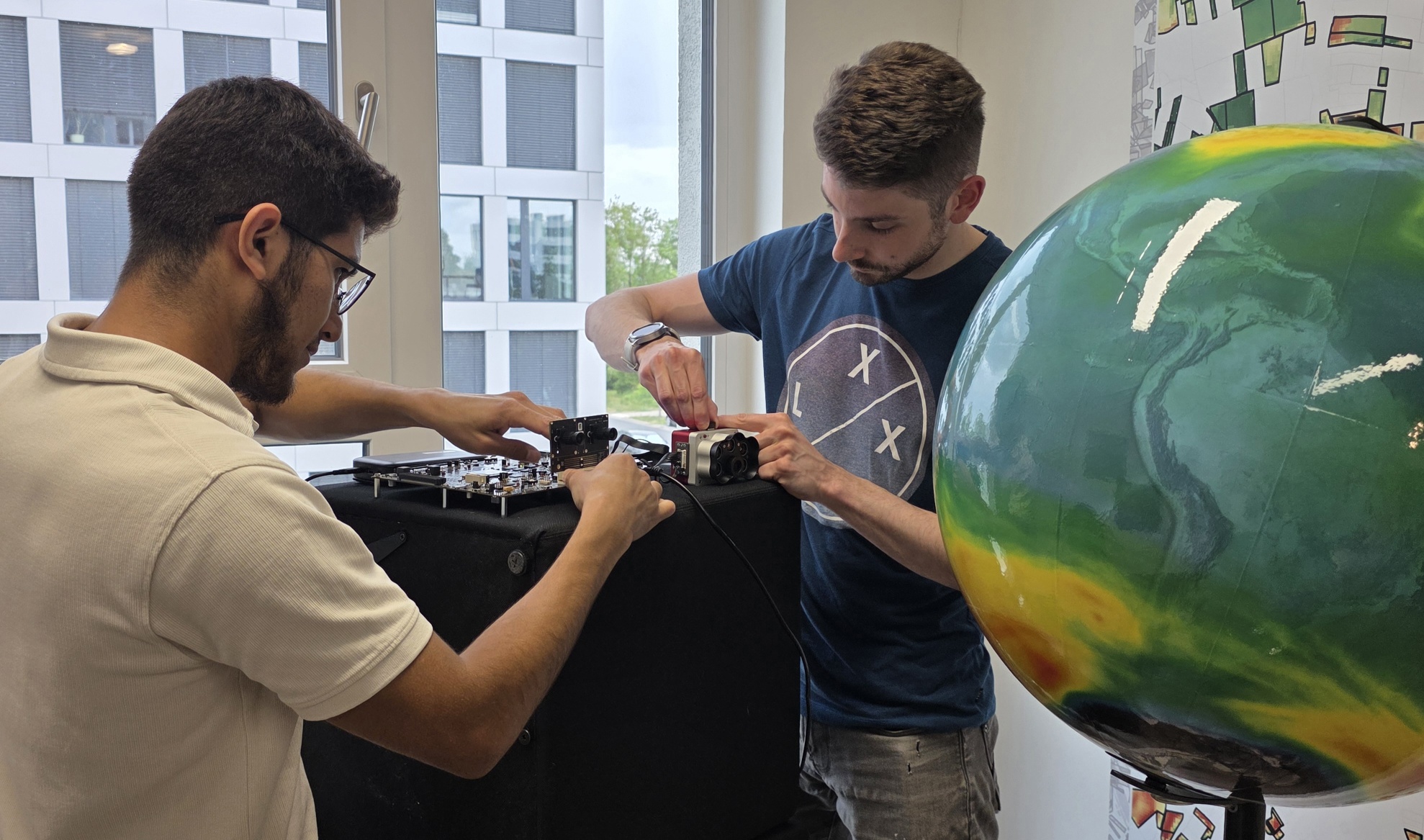
One of the aspects we enjoy most at EORC is the opportunity to collaborate across disciplines. A recent example is our interaction with Moritz Heimbach and Fernando Rodriguez, PhD students in the Embedded Systems and Sensors for Earth Observation (ESSEO) group led by Prof. Marco Schmidt at the University of Würzburg.

Moritz and his colleagues are developing technologies at the intersection of Earth observation, embedded systems, and small satellite missions. As part of this work, they have been using our rotating globes to evaluate different camera systems and imaging concepts for future space applications. The experiments include testing multispectral cameras and investigating how mapping data can be acquired from satellite-like observation geometries using rotating globe surfaces as test targets.

These experiments fit well with the broader research activities of the ESSEO group, which develops technologies ranging from onboard computing and satellite image processing to CubeSat missions and Earth observation sensors and algorithms.

We greatly appreciate these informal collaborations between remote sensing scientists and computer scientists. They often lead to new ideas, unexpected perspectives, and practical opportunities to share infrastructure and expertise.

We are looking forward to following the development of the next generation of spaceborne sensors emerging from the ESSEO group and are excited to see how these technologies will contribute to future Earth observation missions.

follow us and share it on:

you may also like:

DBU scholar Josipa Subotic

DBU scholar Josipa Subotic

Almost a year ago, Josipa Subotic showed up at EORC as a DBU scholar, and now her stay with us is coming to an end. Josipa spent her time digging into snow cover properties around the Zugspitze, working with Sentinel-2 time series data. Multispectral imagery, lots of...

GLS-team visits Planetary Health exhibition

GLS-team visits Planetary Health exhibition

One of the aims of Geolingual Studies Geolingual Studies - Geolingual Studies is to ensure effective science communication beyond the scientific community and into the wider society. The Geolingual Studies team was given the opportunity to look at concepts and methods...

University press covered our anniversaries

University press covered our anniversaries

Einblick, the University of Würzburg's press medium, published an article on our double anniversary, 25 years of Earth observation research and 10 years of EAGLE M.Sc. program, today. Recently, they has visited us at our EORC to hear about our research and teaching...

Mapping Lava Tubes on Mauritius with iPhone Pro LiDAR

Mapping Lava Tubes on Mauritius with iPhone Pro LiDAR

Lava tube structures on Mauritius are quite hard to survey - tight, dark, and largely inaccessible to classical scanning equipment. As part of ongoing research by Dr. Kim Lea Holzmann (Chair of Animal Ecology and Tropical Biology, University of Würzburg), we're...

Johannes Mast wins Bernd Rendel Prize

Johannes Mast wins Bernd Rendel Prize

Johannes Mast is awarded the 2026 Bernd Rendel Prize for Geosciences by the Deutsche Forschungsgemeinschaft (DFG) for outstanding research as part of his dissertation. Johannes’s highly interdisciplinary work bridges the Geosciences, Linguistics, Data Science, and...

Share This