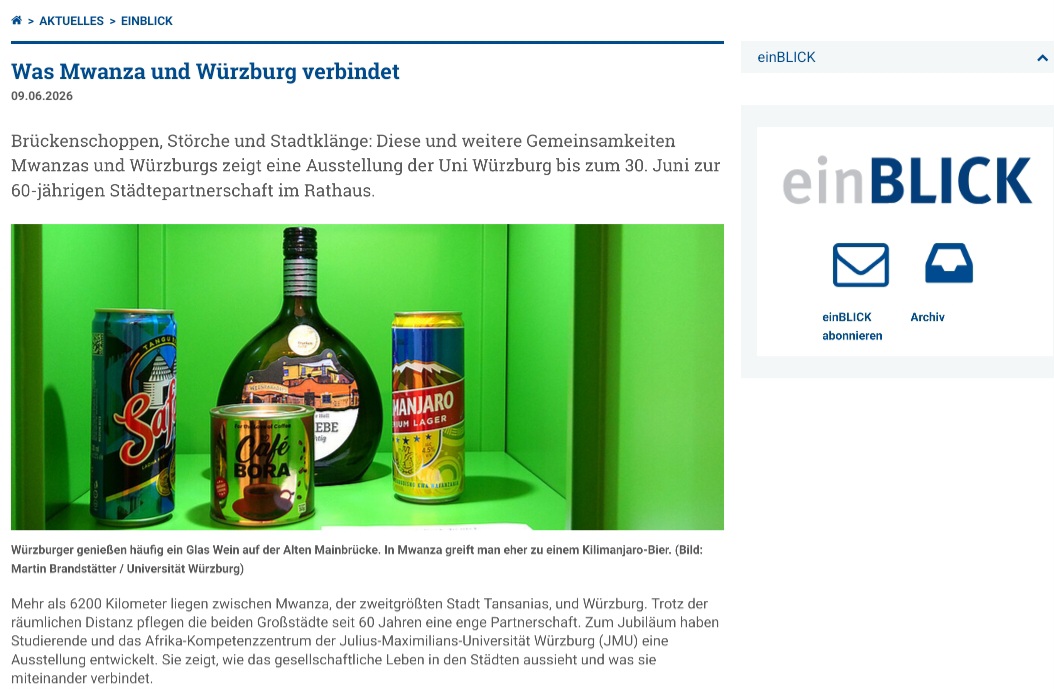

The University of Würzburg’s press team recently featured the exhibition “Living with Science: Stories from Mwanza & Würzburg”, an intercultural science communication project co-organized by our EORC colleague Dr. Sarah Schönbrodt-Stitt and Dr. Michael Thiel. The exhibition forms part of the celebrations marking 60 years of partnership between the cities of Würzburg, Germany, and Mwanza, Tanzania.
Hosted at Würzburg City Hall throughout June 2026, the exhibition presents a unique perspective on science by focusing not only on research itself, but also on the people behind it. Through portraits, interviews, photographs, soundscapes, and personal stories, visitors discover how researchers, students, and communities in both cities experience everyday life, pursue scientific questions, and build international connections.
The project emerged from the interdisciplinary course “Perspectives of Innovative Science Communication” led by Dr. Sarah Schönbrodt-Stitt at the Department of Remote Sensing. Together with students from Würzburg and partner institutions in Tanzania, the exhibition was developed as a collaborative effort that combines science, culture, and public engagement. Participants worked across disciplines to create exhibition materials that explore topics ranging from biodiversity and sustainability to urban life, cultural traditions, and shared experiences between the two partner cities.
As highlighted by the university’s coverage, a central aim of the exhibition is to make science more accessible by telling human stories. Rather than presenting research as abstract knowledge, the exhibition showcases the motivations, aspirations, and personal journeys of young scientists from both Mwanza and Würzburg.
The exhibition was developed through a collaboration between the University of Würzburg, the Africa Competence Centre (ACCUW), and the St. Augustine University of Tanzania in Mwanza. Following its presentation in Würzburg, the exhibition is planned to travel to Mwanza, further strengthening the long-standing partnership between the two cities.
We are pleased to see this project receiving attention from the University’s press team and congratulate Sarah, Michael, all participating students, and the many partners who contributed to making science communication a bridge between cultures, disciplines, and communities.