
new R package to visualize remote sensing data and movement tracks: moveVis

new R package to visualize remote sensing data and movement tracks: moveVis

July 20, 2017

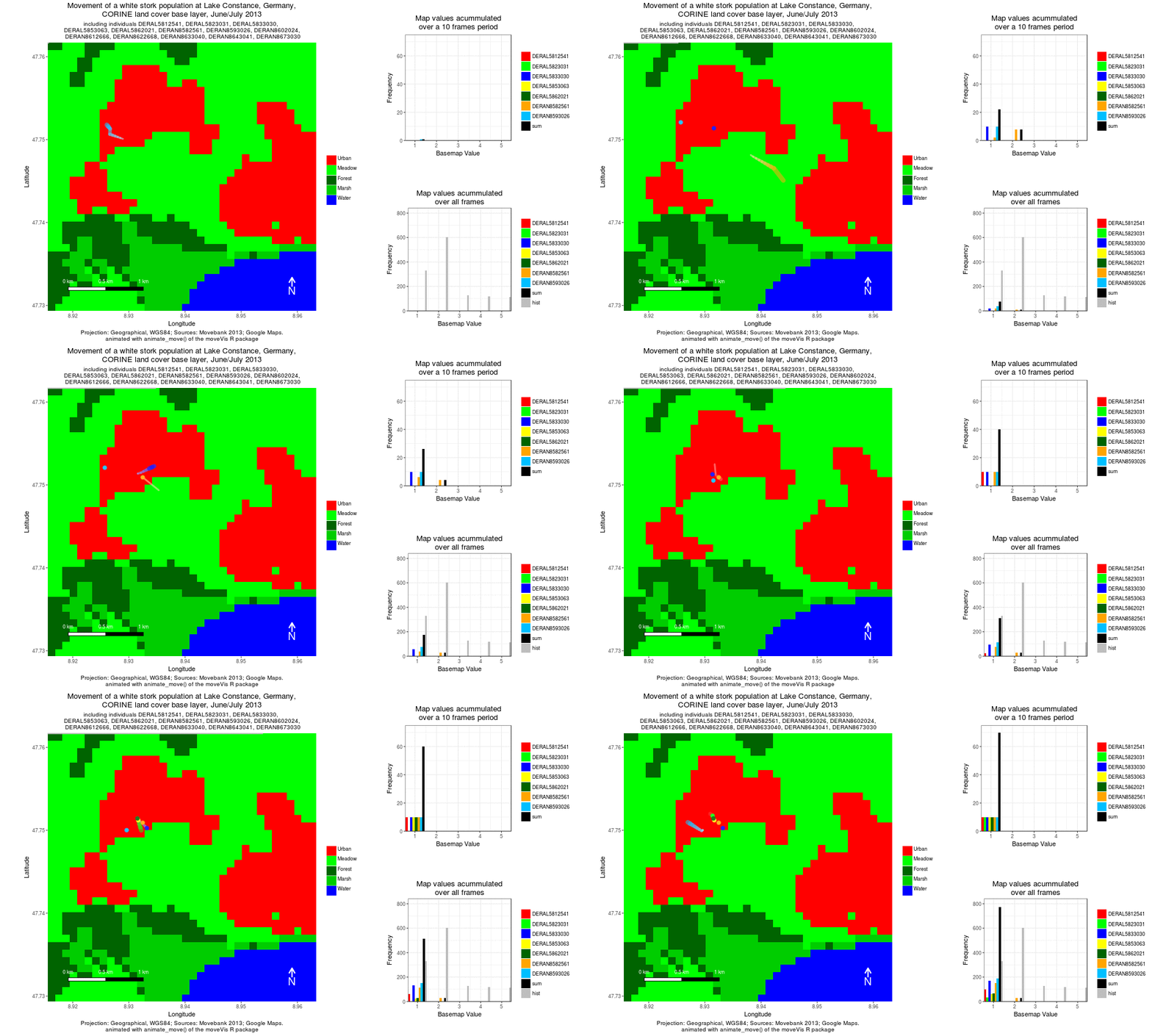
Our EAGLE M.Sc. student Jakob Schwalb-Willmann developed the moveVis package and is now available via CRAN. Beside the animation of movement also the corresponding environmental values can be shown for the whole extent, as cumulative values per individual or across the whole group or just the average value of the last n steps to highlight changes in species-environment relationships. All graphical parameters can be changed by the user via ggplot commands for the map and the statistics graphs. MoveVis will also be covered in the next AniMove course.

Please report any issues to the bug manager at www.movevis.org or post your questions to the AniMove mailing list.


Please also send us (via mail, twitter or FB) your best moveVis animations and we are happy to create a gallery of animations. Please also provide information how to reference the animation (your name, affiliation, email).


This initiative is part of the Opt4Environment project and was funded by the German Aerospace Center (DLR) on behalf of the Federal Ministry for Economic Affairs and Energy (BMWi) with the research grant 50 EE 1403. The movement data we used was provided by the Max Planck institute for Ornithology (MPIo). Click below to reach the involved parties.

 

follow us and share it on:

you may also like:

Help Us Understand Ticks: Join the MONID HABITRACK Study

Help Us Understand Ticks: Join the MONID HABITRACK Study

Lyme borreliosis and tick-borne encephalitis (TBE) are the most common tick-borne diseases in Germany, and they are becoming more relevant. Many infections go unnoticed because they cause mild symptoms or none at all. The MONID HABITRACK project, funded by the BMFTR,...

Setting Up for the 2nd EO4CAM Nutzerworkshop

Setting Up for the 2nd EO4CAM Nutzerworkshop

Right now our staff are busy hauling cases, mounting displays and testing every cable for the 2nd EO4CAM Nutzerworkshop, “Erdbeobachtung für die Klimaanpassung, behördliche Akteure in Bayern”. The doors open tomorrow, and the exhibition...

A dashboard for multi-UAS thermal data

A dashboard for multi-UAS thermal data

Mapping an active fire with various drones flying in parallel is hard enough. But getting the data processed, evaluated and turned into research datasets is a different story. The publication is on its way, and for now we’d like to share a dashboard by Antonio José...

Have you ever wondered how many trees there are on our campus?

Have you ever wondered how many trees there are on our campus?

Sometimes a chat during a formal event like the one for the Urban:Pulse funding celebration, results in something totally different. Following a discussion with the vice-president of our University, we promised to look into the research by one of our PhD students...

Earth Observation at the DFG BETAFOR workshop

Earth Observation at the DFG BETAFOR workshop

Jakob Schwalb-Willmann represented our team at the DFG BETAFOR workshop in the Bavarian Forest National Park. The room was full of biologists, which is the whole point of an interdisciplinary project, and our UAS multisensor time series drew a lot of interest from the...

bzgl. Art. 50 Verordnung (EU) 2024/1689 (AI Act):

Überwiegend werden eigene originäre Texte und Bilder des EORC genutzt, jedoch sind einige Inhalte von blog post Texten teilweise mit Hilfe von KI überarbeitet worden und einige Bilder sind ganz mit KI erstellt, die jedoch deutlich keine photorealistische Darstellungen abbilden. Aussnahmen sind KI generierte fernerkundliche Datensätze, die explizit für Forschungszwecke mit KI erstellt wurden, hier wird aber durch den assoziierten Text der wissenschaftliche Grund der KI generierten Bilder erläutert.

Share This