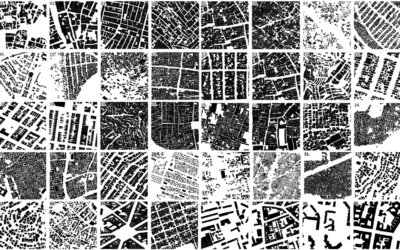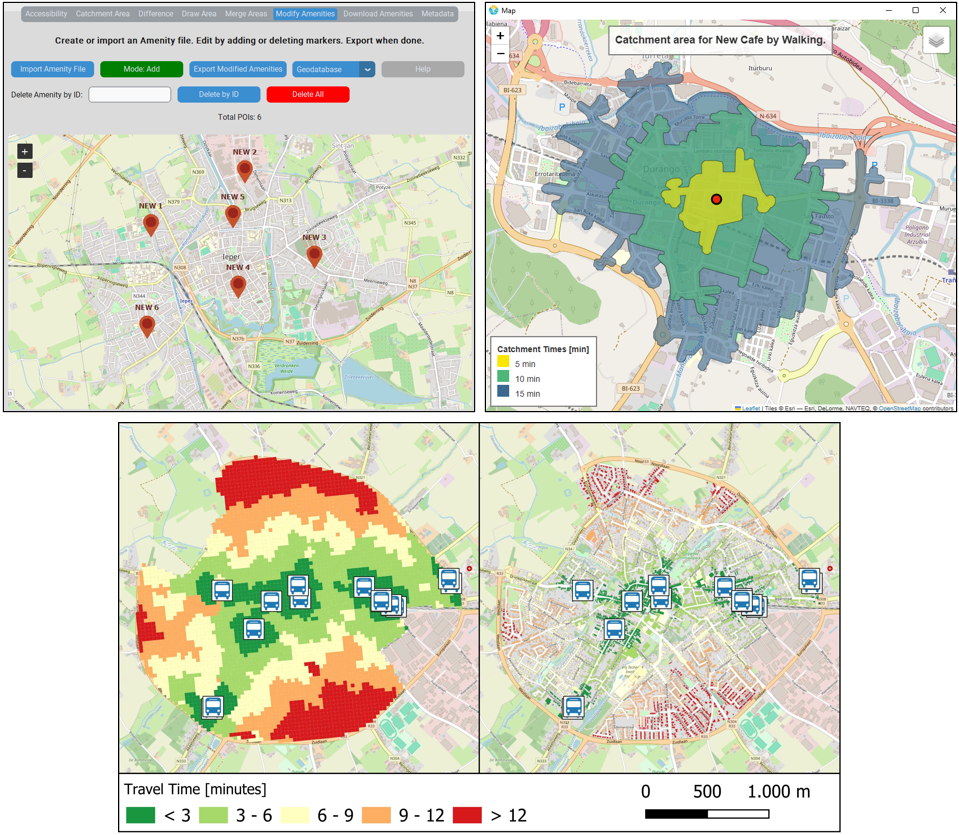

Urban and regional planning increasingly relies on geospatial technologies to support evidence-based decision-making. Within the European research project FUTURAL – Empowering the Future of Rural Regions, researchers at the Earth Observation Center (EOC) of the German Aerospace Center (DLR) have developed a prototype accessibility platform to support regional planners in analyzing and visualizing access to essential services in rural areas. This research work is closely related to our EORC’s research on walkability and permeability in urban areas.
The platform enables users to assess accessibility to critical infrastructure such as healthcare, education, and public services. Beyond accessibility analyses, it integrates additional geospatial functions that allow users to explore planning scenarios and evaluate “what-if” situations. All results are presented through an interactive web platform, providing an intuitive interface for supporting regional planning and decision-making.
The project’s technical documentation has now been published on Zenodo, where it is openly available together with further project-related material.
The FUTURAL accessibility platform was developed at the DLR by Manuel Köberl, Michael Wurm, and Hannes Taubenböck as part of the European FUTURAL project, contributing innovative geospatial tools to strengthen the resilience and sustainability of rural regions.
Zenodo: https://doi.org/10.5281/zenodo.21063509
FUTURAL Project: https://futural-project.eu/
Accessibility Web-Platform: https://quality-of-life.futural-project.eu/
For related research works, we refer to the following publications:
- Spatial Accessibility in Transition: Evaluating Urban Growth and Service Distribution in Westhoek, Belgium. https://ieeexplore.ieee.org/abstract/document/11076063
- Liveability in large housing estates in Germany–Identifying differences based on a novel concept for a walkable city. https://doi.org/10.1016/j.landurbplan.2024.105150
- The Individual Walkable Neighborhood-Evaluating people-centered spatial units focusing on urban density. https://doi.org/10.1016/j.compenvurbsys.2022.101893
- How does pedestrian permeability vary in and across cities? A fine-grained assessment for all large cities in Germany. https://doi.org/10.1016/j.compenvurbsys.2024.102115
- The influence of urban structure types on the x-minuteness of cities: An accessibility analysis of 15 German cities. https://journals.sagepub.com/doi/10.1177/23998083261424942