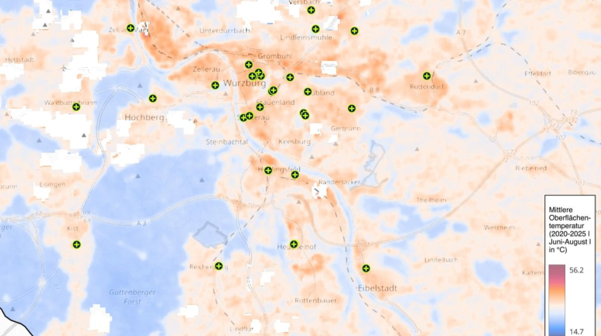

A joint analysis of data journalists from BR24 and scientists from the German Aerospace Center (DLR) revealed that nearly half of all senior homes in Unterfranken are located within urban heat islands. The basis for this analysis are satellite-based observations of land surface temperature (LST) over several years, which were prepared in the context of the EO4CAM project.
According to recent media reports from BR24 and MainPost, many senior homes are located in neighborhoods with high building density, limited green space, and a concentration of man-made heat-absorbing surfaces – conditions that increase surface temperatures and intensify urban heat islands. On the other hand, practical measures for heat adaptation are often scarce since structural modifications to buildings like insulation, green facades and roofs, or the installation of air conditioning are expensive and often difficult to implement. However, there is growing awareness of heat risk in many senior homes, and in some facilities, individual structural measures have already been implemented with financial support from the homeowners or the state government. The data and analysis provided through EO4CAM enables local authorities to prioritize interventions to reduce heat exposure and supports climate adaptation to protect vulnerable populations from increasing exposure to heat.
The work shows the growing media interest in EO applications, demonstrating how remote sensing is shaping urban policy for climate adaptation across Germany.
Read the full stories here:
- BR: Hitzeregion Unterfranken – Gefahr im Seniorenheim
- MainPost: Jedes zweite Seniorenheim liegt im Hitze-Hotspot
- Learn more about EO4CAM at DLR
More research on urban heat adaptation and related topics:
- How city size and urban form influence the surface urban heat island effect https://journals.plos.org/plosone/article?id=10.1371/journal.pone.0340060
- A transferable heat risk index for urban planning https://www.sciencedirect.com/science/article/pii/S2212095525004857
- DLR zeigt hohe Hitzebelastung in deutschen Großstädten https://www.dlr.de/de/aktuelles/nachrichten/2025/dlr-zeigt-hohe-hitzebelastung-in-deutschen-grossstaedten
- The world’s largest cities under climate change and their adaptive capacity to rising heat https://www.nature.com/articles/s41598-025-19954-z
- Exposure to urban heat – Citizen Science and remote sensing for the measurement and modeling of indoor and outdoor temperatures and its influencing factors https://www.sciencedirect.com/science/article/pii/S2212095523001165