remote sensing lecture at AniMove

remote sensing lecture at AniMove

December 14, 2016

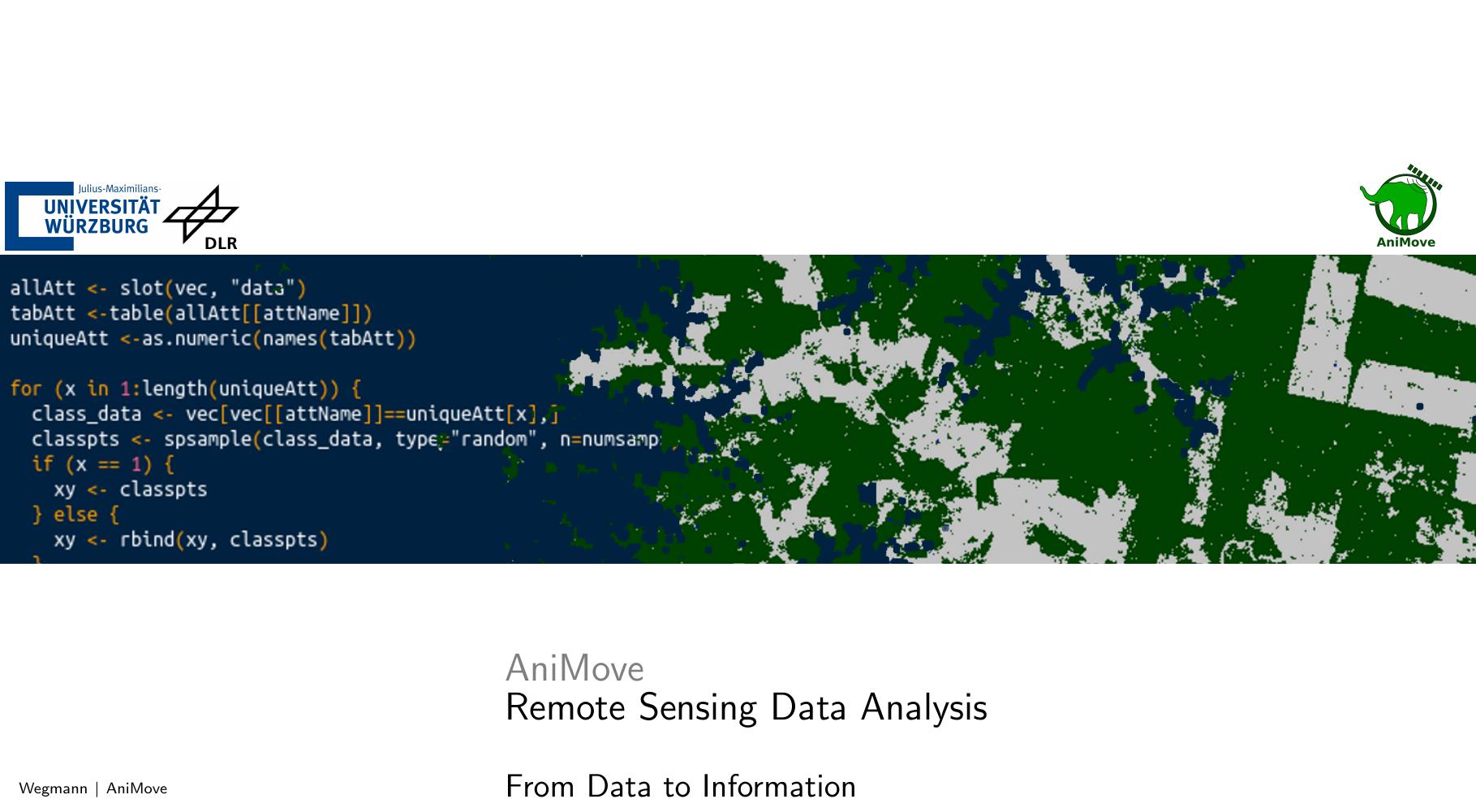
Martin Wegmann and Ruben Remelgado gave a 2 days lecture at the AniMove.org science school at BIK-F in Frankfurt covering applied aspects of remote sensing especially for ecology with a focus on animal movement. More than 20 international PhD and PostDocs attended this winter school, all with their own animal tracking data and specific needs concerning environmental analysis. The basics and background of remote sensing as well as the application was introduced. Moreover, theoretical and practical parts covered data visualization, data import and export, computation of vegetation indices, unsupervised classification, supervised classification, generation of vector training data and projection issues. All practical courses were using R and QGIS to comply to the standards of AniMove.


Additionally, Martin Wegmann is part of the AniMove board and jointly with the colleagues from MPI, Smithsonian and BIK-F the dates, locations and aims of the AniMoves in 2017 any beyond were discussed. More details will be posted soon on www.animove.org



follow us and share it on:

you may also like:

Remote sensing insights into biogas flowering mixtures

Remote sensing insights into biogas flowering mixtures

Perennial wildflower mixtures are gaining importance as an alternative to maize in biogas production. As highlighted in the praxis-agrar article on crop diversification with biogas flowering mixtures, they combine agricultural use with clear ecological benefits....

PhD submitted by Julia Rieder

PhD submitted by Julia Rieder

We are pleased to share that our PhD student Julia Rieder has successfully submitted her doctoral thesis! Her dissertation, entitled “Abiotic and biotic drivers of drought responses in European beech (Fagus sylvatica L.) inferred from field and LiDAR data”,...

New Funded Project on Automated Detection of Mining Areas

New Funded Project on Automated Detection of Mining Areas

In a newly launched research project funded by the KSB Foundation, we focus on the automated identification of mining areas based on remote sensing data. The aim is to systematically detect large-scale mining activities and to track their spatial and temporal...

Share This