
Workshop Report at the Department of Remote Sensing – February 10, 2021

Workshop Report at the Department of Remote Sensing – February 10, 2021

m

February 5, 2021

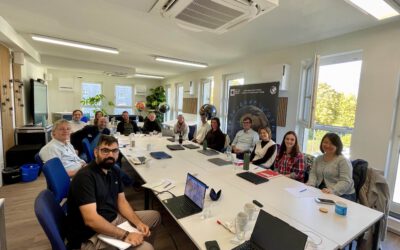
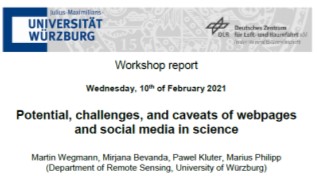
We are glad to announce our next workshop report at the Department of Remote Sensing! On 10th of February, Martin Wegmann, Mirjana Bevanda, Pawel Kluter, and Marius Philipp (all Department of Remote Sensing at the University of Würzburg) will talk about Potential, challenges, and caveats of webpages and social media in science”.

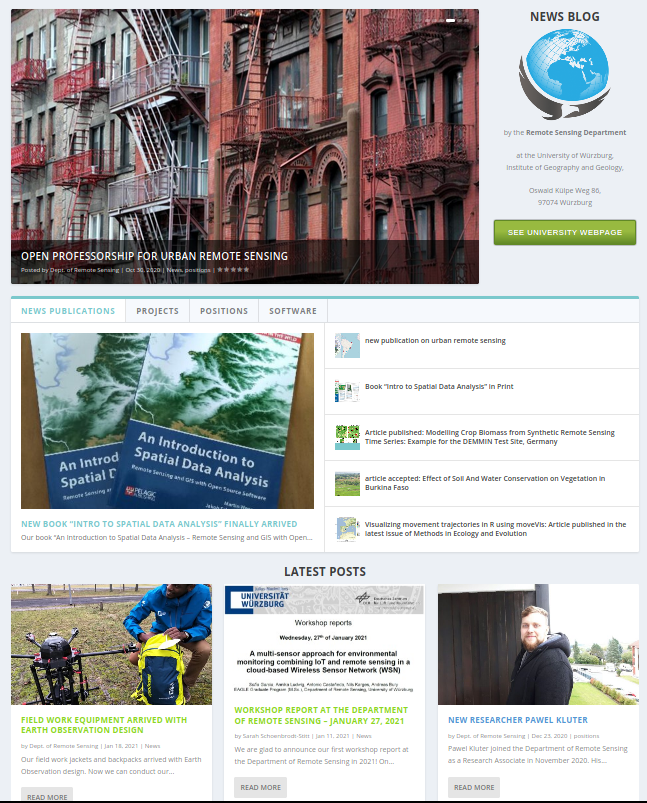
Abstract

Embracing online presence such as webpages and social media can provide a huge potential for science. However, it is sometimes considered too complex and time-consuming without providing the same impact as e.g. conference participation. Within this seminar, we would like to critically discuss the value and challenges of online presentations of scientific content for Earth Observation colleagues and beyond. We like to outline the already achieved benefits of our online activities through diverse webpages and social media, as well as the future potential and challenges. Additionally, we will practically show how news can be posted and webpages can be build and that it can be achieved with little time and effort. Online presence should not be considered as a replacement for handing out business cards, doing networking or presenting research findings at conferences but as a great alternative for the time in-between.
Title of presentation: Potential, challenges, and caveats of webpages and social media in science Presenters: Martin Wegmann, Mirjana Bevanda, Pawel Kluter, and Marius Philipp (all Department of Remote Sensing at the University of Würzburg)

Date: Wednesday, 10th of February, 2021 Time: 10 – 11 am s.t. Place: Online Presentation language: English Slides: English

follow us and share it on:

you may also like:

MainPro workshop on TLS and LiDAR UAS

MainPro workshop on TLS and LiDAR UAS

This week, a workshop organized by Sebastian Buchelt within our EFRE project MainPro brought together students, researchers, and interested project partners to explore modern UAV technologies. The workshop took place in vineyards close to Würzburg and gave the...

25 Years of Remote Sensing in Würzburg

25 Years of Remote Sensing in Würzburg

Our chair of remote sensing, Professor Stefan Dech, likes to say "science is rarely a sprint, it's a marathon". And if you look at what's grown out of Würzburg over the last 25 years, you'll see exactly what he means. In 2026 the Julius-Maximilians-Universität...

Starkregen in Bayern: Beobachtungen und Dokumentation zählen

Starkregen in Bayern: Beobachtungen und Dokumentation zählen

Starkregenereignisse treten immer häufiger lokal, kurzfristig und mit hoher Intensität auf. Innerhalb weniger Stunden können sie erhebliche Überschwemmungen und Schäden verursachen. Um solche Ereignisse künftig besser zu verstehen und die wissenschaftliche Grundlage...

Seeing the World in Points: Lidar Course for the EAGLEs

Seeing the World in Points: Lidar Course for the EAGLEs

Lidar has a funny way of sneaking up on you. You think you know what it is, a laser that measures distance, fine, but then someone shows you a point cloud of a forest canopy with individual branches floating in 3D space and suddenly you realize there's a whole...

TV Crew Films EORC at MONID Habitrack Fieldwork

TV Crew Films EORC at MONID Habitrack Fieldwork

A bit of extra excitement at EORC recently: A television crew showed up to film a segment on the MONID Habitrack project financed by the BMFTR, and Dr. Ariane Droin was right in the middle of it, walking them through what Earth...

Ticks from Above: UAS Fieldwork for the MONID Habitrack Project

Ticks from Above: UAS Fieldwork for the MONID Habitrack Project

Forest edges are tricky places. They're where woodland meets open ground, where light and shade trade off every few meters, and where, it turns out, ticks tend to do really well. That last bit is exactly why Dr. Ariane Droin, Sofica Garcia de Leon, Dr. Jakob...

Share This