
Geolingual Studies Workshop – Day 2

Geolingual Studies Workshop – Day 2

September 28, 2023

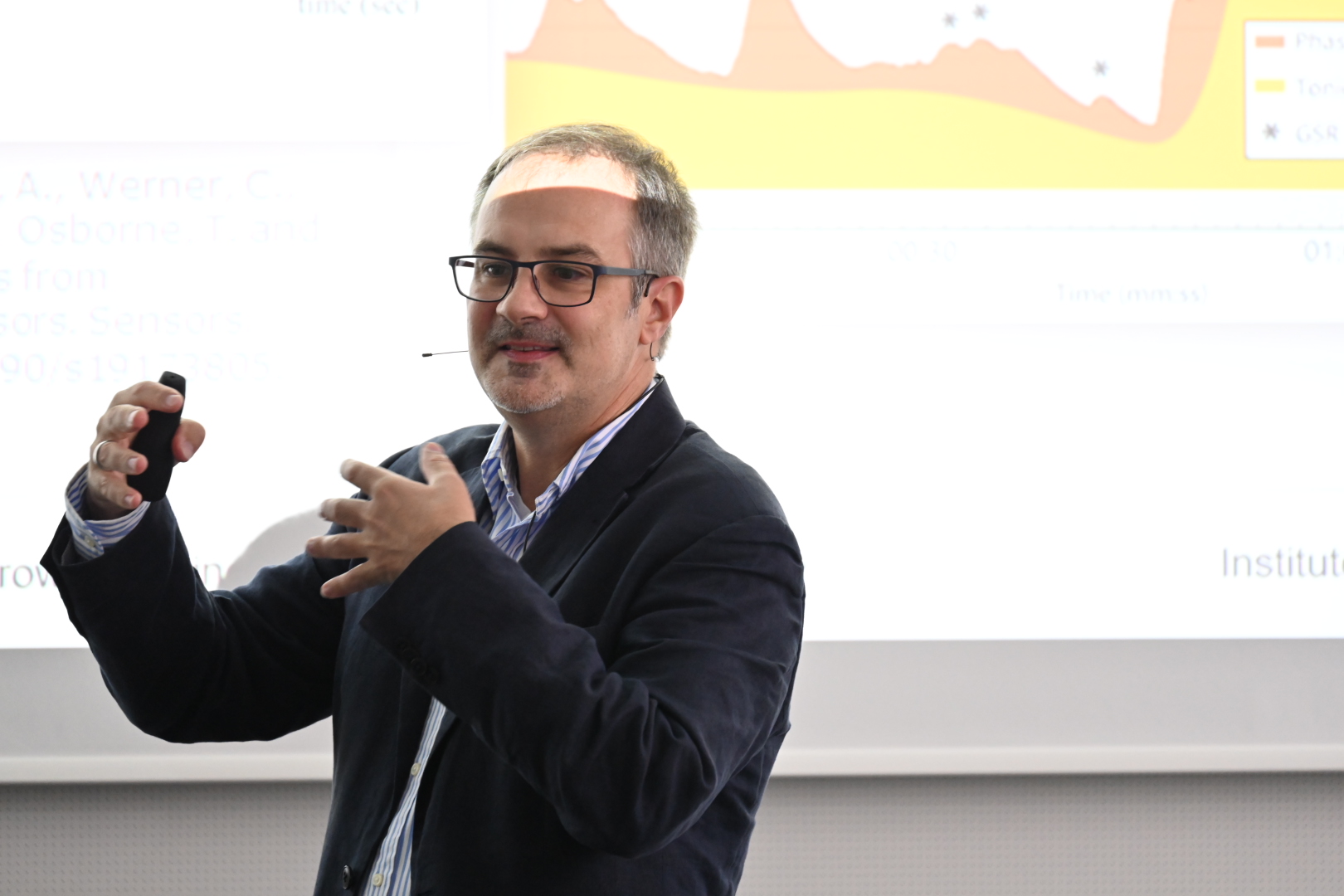
The second day of the Geolingual Studies workshop started with an inspiring keynote held by Dr. Peter Zeile from the Karlsruhe Institute of Technology (KIT). His talk was titled: “People Centric Urban Data – Crowdsourcing, Emotions, Bicycles and more”. He presented urban planning as the attempt to eliminate a “wicked problem” all factors must be considered and weighted within the framework of the consideration. This talk introduced how to get data about the residents of the city to assess invisible factors that are difficult to measure by established methods – for example, cycling, digital methods and emotions as examples of planning tools.

Ankhi Mukherjee from the University of Oxford provided an eye-opening keynote titled “Open, closed, and interrupted city”. In her inspiring talk she proposed interruption as a chronotope, with its intrinsic interconnectedness and spatial relationships. She introduced different pathologies of interruption: that of unfinished, untold stories; truncated lives; the metaphysics of a non-tactilist touch; the clinical interruptions that structure immigrant psychoanalysis.

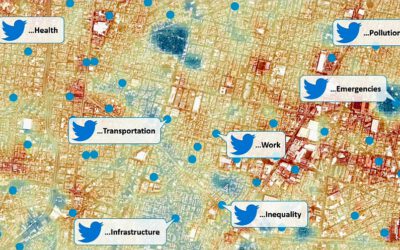
In the session “Twitter data in GLS”, Martin Mühlbauer and Ralph Kiefl from der German Aerospace Center (DLR) presented examples of the preprocessing of textual data from the WWW: GDELT and Twitter. Marta Sapena-Moll from the DLR introduced her study on leveraging Twitter data to support risk assessment in Medellín, Colombia. Additionally, Regina Grund explored online conversations on popular culture, with Twitter data from New York City.

In the session “Language, space and emotion”, Matthias Gamer gave a talk titled “How anxiety changes our view of the world”. In his presentation he showed how emotions influence human behaviour, in particular the patterns of use of space. Alex Gomes presented her work on “Beyond the visual: Understanding the impact of sensory experiences in public space use”. In this talk, she stressed how data on people’s senses such as smell, touch and hearing can provide relevant insights to assess urban spaces.

Finally, Karen Chen’s talk was on her study on the risk of depression change across urban morphology. In her talk she highlighted the relevance of prioritizing access to open space in densely built areas to mitigate depression risks.

follow us and share it on:

you may also like:

Keynote by John Friesen at the 8th Network Meeting of the BayWISS

Keynote by John Friesen at the 8th Network Meeting of the BayWISS

Seeing the Future – EORC contributes to the 8th Network Meeting of the BayWISS Verbundkollegs Digitalisierung  in IngolstadtAt this year’s BayWISS network meeting in Ingolstadt on the 11th of December, attended primarily by doctoral candidates from the...

Participation in the 2nd RGV Intercomparison workshop

Participation in the 2nd RGV Intercomparison workshop

Last week (4 – 5 Dezember), our team member Sebastian Buchelt participated in the 2nd RGV intercomparison workshop, which took place in Fribourg, Switzerland. Together with researchers from several different countries, they discussed about developing guidelines...

Invited evening lecture at the Werkbund in Munich

Invited evening lecture at the Werkbund in Munich

The Deutscher Werkbund Bayern e. V. has invited Prof Dr Hannes Taubenböck to give an evening lecture in Munich on the 8th of December 2025. The Werkbund aims to provide impulses for industrial and design culture and works towards a high-quality design of the human...

Inspiring EORC talk by Dr. Martin Fleischmann

Inspiring EORC talk by Dr. Martin Fleischmann

Today, we were honored to have Dr. Martin Fleischmann from the Department of Social Geography and Regional Development of the Charles University in Prague, Czechia at our EORC. Martin focusses in his research on urban morphology and spatial data science. He gave an...

Share This