
new B.Sc. thesis: UAV-based cemetery map

new B.Sc. thesis: UAV-based cemetery map

June 20, 2018

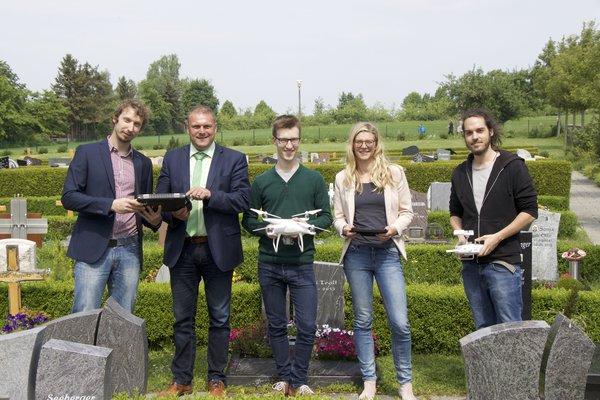
from left to right: Hendrik Flock, Thomas Eberth, Florian Baumgartner, Carina Kübert and Steven Hill, source: MainPost

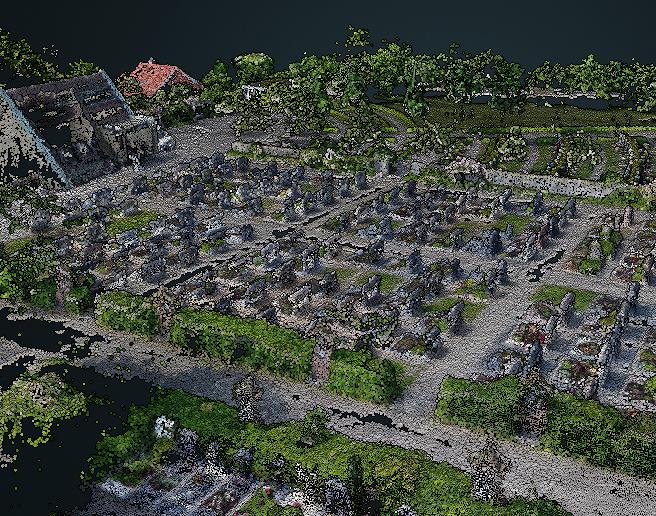
Florian Baumgartner started his B.Sc. thesis titled “Object-oriented derivation of a digital cemetery plan from very high resolution aerial imagery – a case study for the municipality of Kürnach”. The aim of his thesis is to derive a high-resolution UAV-based graveyard map that can be used by the municipality for further planning within the cemetery administration.

Florian has already planned and performed an overflight with our Phantom 4 drone that took place in April this year. Watched by the mayor of Kürnach (Thomas Eberth), a representative of the AKDB (public agency developing IT solutions for municipal authorities, Hendrik Flock) our UAV expert (Steven Hill) and me (mentoring the thesis), the drone was flying at a height of 30m for 15 minutes and took more than 200 images.


The images will be used to derive a georeferenced orthophoto as well as a three-dimensional Digital Surface Model.
Florian will apply object-oriented segmentation and classification methods in order to develop a digital cemetery map. His thesis can be seen as a feasibility study within the process of the digitization of administrative tasks.

More information can be found here:
Best practice Tutorial for low budget UAV (in English and German)
report written by the municipality of Kürnach (in German only)
report written by AKDB (in German only)
report of the local daily newspaper MainPost (in German only)

follow us and share it on:

you may also like:

AI chatbots in research and teaching

AI chatbots in research and teaching

Let's be honest about something: AI chatbots are not coming to our courses and our research. They are already here, and they have been for a while. ChatGPT, Claude, Perplexity, Gemini, whatever your tool of choice is, our students have been using these things for...

Drone manufacturer Wingtra visits EORC

Drone manufacturer Wingtra visits EORC

Is it possible to combine the efficiency of a fixed-wing drone with the precision of a laser scanner? That question brought researchers from EORC together with Wingtra, a Swiss company designing and manufacturing fixed-wing UAS, to exchange on UAS research and discuss...

How We Learned to Fly: The Story Behind UAS Research at EORC

How We Learned to Fly: The Story Behind UAS Research at EORC

Every research group that's ever bought a drone has a story about the first one it lost. We're no different. So let's just get that out of the way up front: this is the inside story of how UAS (Unoccupied Aerial System) research grew up at the Earth Observation...

MainPro workshop on TLS and LiDAR UAS

MainPro workshop on TLS and LiDAR UAS

This week, a workshop organized by Sebastian Buchelt within our EFRE project MainPro brought together students, researchers, and interested project partners to explore modern UAV technologies. The workshop took place in vineyards close to Würzburg and gave the...

25 Years of Remote Sensing in Würzburg

25 Years of Remote Sensing in Würzburg

Our chair of remote sensing, Professor Stefan Dech, likes to say "science is rarely a sprint, it's a marathon". And if you look at what's grown out of Würzburg over the last 25 years, you'll see exactly what he means. In 2026 the Julius-Maximilians-Universität...

Starkregen in Bayern: Beobachtungen und Dokumentation zählen

Starkregen in Bayern: Beobachtungen und Dokumentation zählen

Starkregenereignisse treten immer häufiger lokal, kurzfristig und mit hoher Intensität auf. Innerhalb weniger Stunden können sie erhebliche Überschwemmungen und Schäden verursachen. Um solche Ereignisse künftig besser zu verstehen und die wissenschaftliche Grundlage...

Share This