
Presentation at the IEEE workshop MetroAgriFor 2020

Presentation at the IEEE workshop MetroAgriFor 2020

m

November 6, 2020

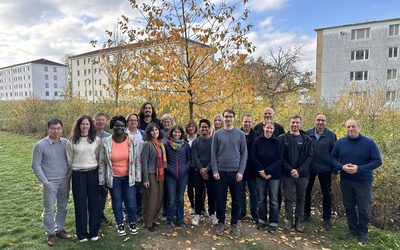
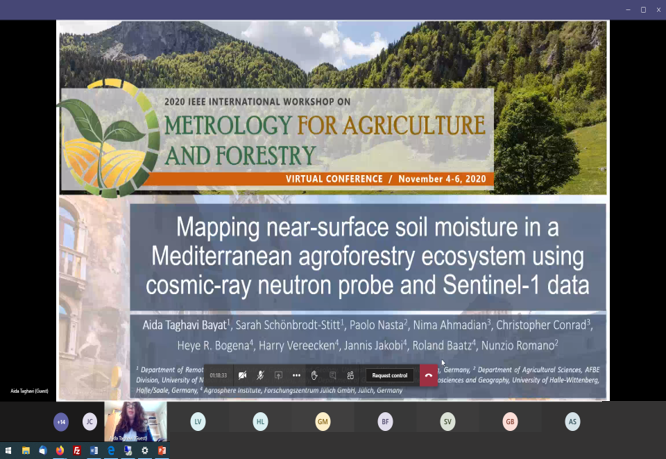
On November 4, the EAGLE MSc student Aida Tagahvai Bayat presented recent activities on “Mapping near-surface soil moisture in a Mediterranean agroforestry ecosystem using cosmic-ray neutron probe and Sentinel-1 data” in Session 1.5 – Special Session on Integrated Water Management for Agriculture (PART I): Sensing, Modeling, and Data Integration – PART 1. The research is conducted in close collaboration with colleagues from the Department of Remote Sensing at the University of Würzburg, the Department of Agricultural Sciences (AFBE Division) at the University of Napoli Federico II in Naples, Italy, the Department of Geoecology at the University of Halle-Wittenberg in Halle/Saale, and at the Agrosphere Institute at Forschungszentrum Jülich. The presentation highlights the enormous potential of integrating soft data such as Sentinel-1 SAR-based measurements, topographic information, and Cosmic-ray neutron probe data to map the near-surface soil moisture at high spatiotemporal resolution (17 m grid size, 6 days) in a small-scale agroforestry experimental site (~ 30 ha) in southern Italy.
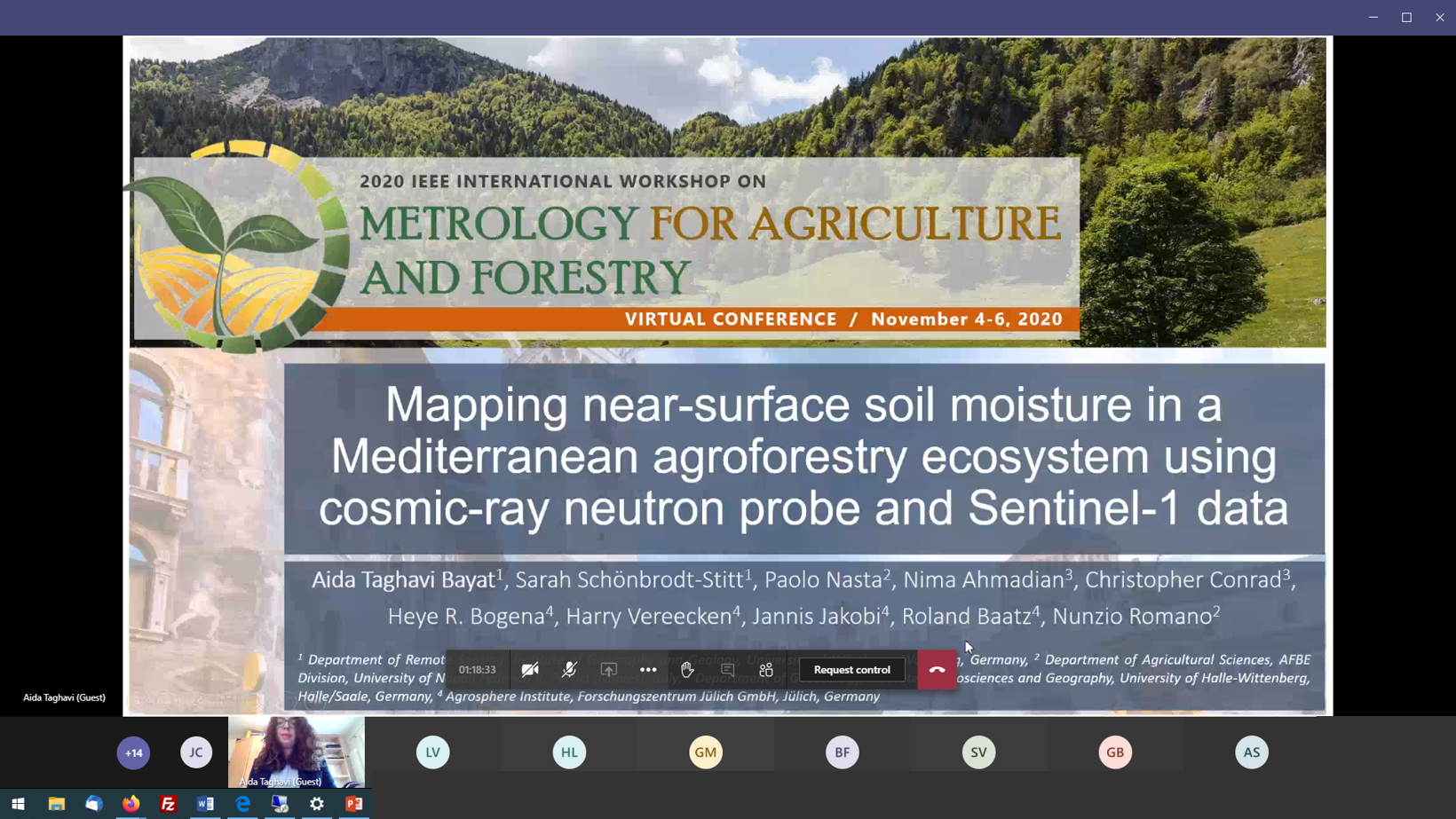
Taghavi Bayat, A.; Schönbrodt-Stitt, S.; Nasta, P.; Ahmadian, N.; Conrad, C.; Bogena, H.R.; Vereecken, H.; Jakobi, J.; Baatz, R.; Romano, N. Mapping near-surface soil moisture in a Mediterranean agroforestry ecosystem using cosmic-ray neutron probe and Sentinel-1 data. in 2020 IEEE International Workshop on Metrology for Agriculture and Forestry (MetroAgriFor), Trente, Italy, virtual conference.

follow us and share it on:

you may also like:

A dashboard for multi-UAS thermal data

A dashboard for multi-UAS thermal data

Mapping an active fire with various drones flying in parallel is hard enough. But getting the data processed, evaluated and turned into research datasets is a different story. The publication is on its way, and for now we’d like to share a dashboard by Antonio José...

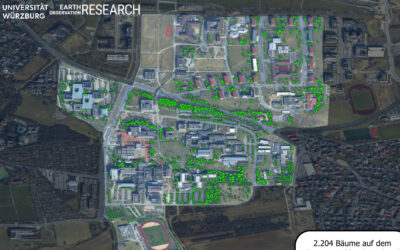
Have you ever wondered how many trees there are on our campus?

Have you ever wondered how many trees there are on our campus?

Sometimes a chat during a formal event like the one for the Urban:Pulse funding celebration, results in something totally different. Following a discussion with the vice-president of our University, we promised to look into the research by one of our PhD students...

Earth Observation at the DFG BETAFOR workshop

Earth Observation at the DFG BETAFOR workshop

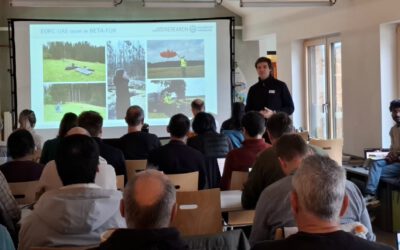
Jakob Schwalb-Willmann represented our team at the DFG BETAFOR workshop in the Bavarian Forest National Park. The room was full of biologists, which is the whole point of an interdisciplinary project, and our UAS multisensor time series drew a lot of interest from the...

Thermal Drone Data Acquisitions: CalVal project with Informatics

Thermal Drone Data Acquisitions: CalVal project with Informatics

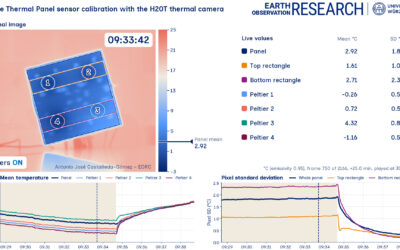
Thermal cameras on drones look very good - visually. They show us temperature of our study objects be it stressed trees, warm patches in a city or active fires. But we do not yet know for sure how far we can trust the temperature values they deliver especially when...

Würzburger Förderpreis awarded to our URBAN:Pulse project

Würzburger Förderpreis awarded to our URBAN:Pulse project

“A remote sensing scientist, a social geographer, an informatics researcher, a sports researcher, a psychologist, a linguist and an economist meet ... what sounds like the start of a joke, was the start of a great interdisciplinary research project.” That’s how Hannes...

Annual Meeting of the NetCDA consortium

Annual Meeting of the NetCDA consortium

On November 3-4, 2026, the NetCDA II (European Academic Network for Capacity Development in Climate Change Adaptions in Africa) project network of 12 German academic partners met at the EORC for their annual meeting. We welcomed our new German research institutions on...

bzgl. Art. 50 Verordnung (EU) 2024/1689 (AI Act):

Überwiegend werden eigene originäre Texte und Bilder des EORC genutzt, jedoch sind einige Inhalte von blog post Texten teilweise mit Hilfe von KI überarbeitet worden und einige Bilder sind ganz mit KI erstellt, die jedoch deutlich keine photorealistische Darstellungen abbilden. Aussnahmen sind KI generierte fernerkundliche Datensätze, die explizit für Forschungszwecke mit KI erstellt wurden, hier wird aber durch den assoziierten Text der wissenschaftliche Grund der KI generierten Bilder erläutert.

Share This