
New publication: vegetation response to environmental variables in the mountainous forests of Western Himalaya

New publication: vegetation response to environmental variables in the mountainous forests of Western Himalaya

May 23, 2017

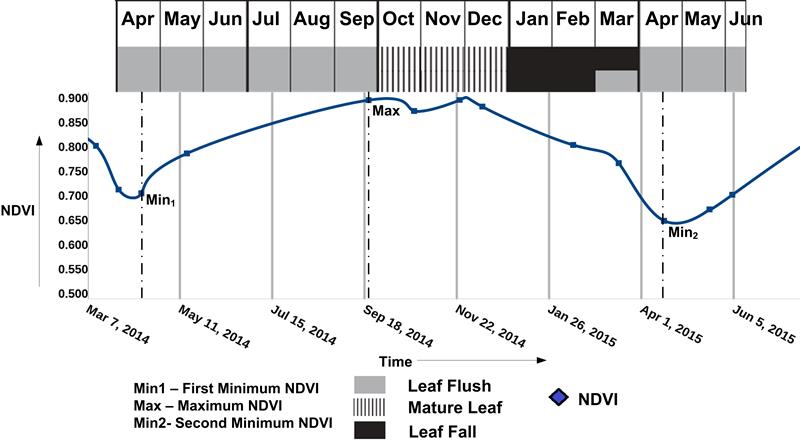
A recently published paper featuring Hooman Latifi and Thorsten Dahms from Dept. of Remote Sensing presents novel results on phenological behaviour of the moist deciduous forests Hymalayan foothills in India during 2013–2015 using Landsat 8 time series data. The paper has been published in International Journal of Remote Sensing, and additionally suggests a new vegetation index called the temporal normalized phenology index (TNPI) to quantify the change in trajectories of Landsat 8 OLIderived normalized difference vegetation index (NDVI) during two time steps of the vegetation growth cycle.
 

Mean NDVI values from April 2014 to June 2015 plotted for study site along with SAL tree
phenology.


Based on cross-validated statistics the paper concludes that  TNPI is a superior alternative for the analysis of temporal phenology cycle between two time steps of maximum and minimum vegetation growth periods. This could, in turn, reduce the requirement of large time-series remote-sensing data sets for studies on long-term vegetation phenology. The paper can be retrieved here.

Bibliography:

Khare, S., Ghosh, S.K., Latifi, H., Vijay,S., Dahms,T. 2017. Seasonal-based analysis of vegetation response to environmental variables in the mountainous forests of Western Himalaya using Landsat 8 data. International Journal of Remote Sensing 38(15), 4418-4442.

follow us and share it on:

you may also like:

Johannes Mast wins Bernd Rendel Prize

Johannes Mast wins Bernd Rendel Prize

Johannes Mast is awarded the 2026 Bernd Rendel Prize for Geosciences by the Deutsche Forschungsgemeinschaft (DFG) for outstanding research as part of his dissertation. Johannes’s highly interdisciplinary work bridges the Geosciences, Linguistics, Data Science, and...

New Technical publication on Regional Planning Smart Solution

New Technical publication on Regional Planning Smart Solution

Urban and regional planning increasingly relies on geospatial technologies to support evidence-based decision-making. Within the European research project FUTURAL – Empowering the Future of Rural Regions, researchers at the Earth Observation Center (EOC) of the...

Ticks from Above: UAS Fieldwork for the MONID Habitrack Project

Ticks from Above: UAS Fieldwork for the MONID Habitrack Project

Forest edges are tricky places. They're where woodland meets open ground, where light and shade trade off every few meters, and where, it turns out, ticks tend to do really well. That last bit is exactly why Dr. Ariane Droin, Sofía García de León, Dr. Jakob...

Share This