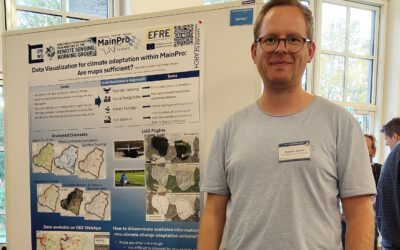

WASCAL-DE-COOP Workshop in 2021

WASCAL-DE-COOP Workshop in 2021

March 30, 2021

The first out of six workshops in early 2021 for our WASCAL students took place virtually about intercultural differences and good communication. We addressed various topics such as the responsibility of a supervisor, scientific expectations as well as the preparation of online meetings. Also the current situation due to the pandemic and its impact on their research stay in Germany at our partner universities was discussed. Our WASCAL graduate students conduct climate change research within different topics, such as agriculture, energy or biodiversity science. We are still optimistic that the development of the current COVID-19 pandemic will allow us to welcome the students for a research stay in Germany later this year or next year.


The workshop was led by Sabine Oppmann, Dr. Mirjana Bevanda and Dr. Michael Thiel by the WASCAL-DE-Coop team in Würzburg

follow us and share it on:

you may also like:

Würzburger Förderpreis awarded to our URBAN:Pulse project

Würzburger Förderpreis awarded to our URBAN:Pulse project

“A remote sensing scientist, a social geographer, an informatics researcher, a sports researcher, a psychologist, a linguist and an economist meet ... what sounds like the start of a joke, was the start of a great interdisciplinary research project.” That’s how Hannes...

Annual Meeting of the NetCDA consortium

Annual Meeting of the NetCDA consortium

On November 3-4, 2026, the NetCDA II (European Academic Network for Capacity Development in Climate Change Adaptions in Africa) project network of 12 German academic partners met at the EORC for their annual meeting. We welcomed our new German research institutions on...

bzgl. Art. 50 Verordnung (EU) 2024/1689 (AI Act):

Überwiegend werden eigene originäre Texte und Bilder des EORC genutzt, jedoch sind einige Inhalte von blog post Texten teilweise mit Hilfe von KI überarbeitet worden und einige Bilder sind ganz mit KI erstellt, die jedoch deutlich keine photorealistische Darstellungen abbilden. Aussnahmen sind KI generierte fernerkundliche Datensätze, die explizit für Forschungszwecke mit KI erstellt wurden, hier wird aber durch den assoziierten Text der wissenschaftliche Grund der KI generierten Bilder erläutert.

Share This