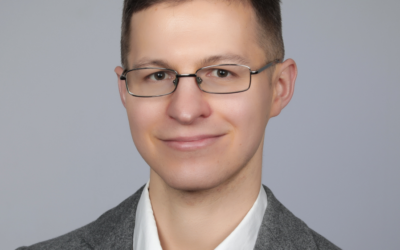

new PhD student Patrick Kacic

new PhD student Patrick Kacic

October 19, 2022

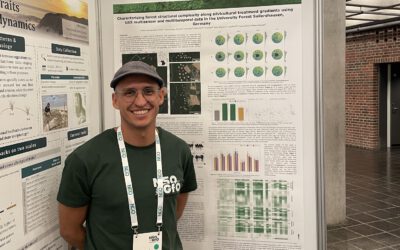
Patrick studied a Bachelor in Geography at the University of Heidelberg with a thesis on land cover change and landslide events in Southern Tyrol (internship at Eurac Research, Bolzano, Italy). To deepen his remote sensing experience, Patrick studied a Master degree in Environmental Sciences with a focus on environmental modelling using remote sensing and ecological data at the University of Freiburg. An internship at the German Aerospace Center (DLR) was followed by a master thesis on vegetation structure modelling for the Paraguayan Chaco in the context of the DLR project Geo-ForPy. In September 2022, Patrick joined the Department of Remote Sensing as a PhD student in the BETA-FOR project which focuses on the assessment of biodiversity in German forests based on complementary remote sensing data.

follow us and share it on:

you may also like:

New Team Member Magdalena Lauermann

New Team Member Magdalena Lauermann

We are delighted to welcome Magdalena Lauermann, who joined the Earth Observation Research Cluster (EORC) in October as a researcher working on the AQUAMOS project. Magdalena has a background in physical geography, with a particular research focus on hydrological...
Reports on the Bernd Rendel Prize won by Johannes Mast

Reports on the Bernd Rendel Prize won by Johannes Mast

We are delighted that Johannes Mast has been awarded the Bernd Rendel Prize by the German Research Foundation (DFG) for his original and promising geoscientific research carried out prior to his PhD. We had already reported on this:...

Johannes Mast wins Bernd Rendel Prize

Johannes Mast wins Bernd Rendel Prize

Johannes Mast is awarded the 2026 Bernd Rendel Prize for Geosciences by the Deutsche Forschungsgemeinschaft (DFG) for outstanding research as part of his dissertation. Johannes’s highly interdisciplinary work bridges the Geosciences, Linguistics, Data Science, and...

bzgl. Art. 50 Verordnung (EU) 2024/1689 (AI Act):

Überwiegend werden eigene originäre Texte und Bilder des EORC genutzt, jedoch sind einige Inhalte von blog post Texten teilweise mit Hilfe von KI überarbeitet worden und einige Bilder sind ganz mit KI erstellt, die jedoch deutlich keine photorealistische Darstellungen abbilden. Aussnahmen sind KI generierte fernerkundliche Datensätze, die explizit für Forschungszwecke mit KI erstellt wurden, hier wird aber durch den assoziierten Text der wissenschaftliche Grund der KI generierten Bilder erläutert.

Share This