
Geolingual Studies constitute a new interdisciplinary field of research integrating linguistics and geography.
The establishment and advancement of this research endeavour has been funded within the “Momentum” programme of the Volkswagen Foundation.
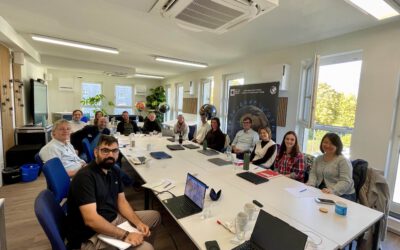
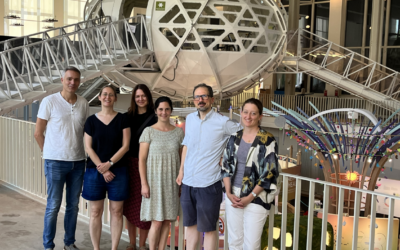
Prof. Dr. Carolin Biewer (English linguistics) and Prof. Dr. Hannes Taubenböck (Remote sensing, German Aerospace Center & EO Research Hub) are the team leaders. Further members of the core team are Dr. Richard Lemoine Rodríguez, Dr. Alena Soloshenko, Dr. Ninja Schulz, Lisa Lehnen, M.A. Researchers from the Department of English linguistics ( https://www.neuphil.uni-wuerzburg.de/anglistik/abteilungen/englische-sprachwissenschaft/startseite/ ) collaborate with a team of researchers from our Earth Observation Research Hub and the Earth Observation Center of the German Aerospace Center ( https://www.dlr.de/eoc/de/desktopdefault.aspx/tabid-5290/9370_read-18028/ ).
The aim of the multidisciplinary research team is to assess the interrelationship between physical and socio-cultural space from a new perspective. For this, the description of the physical environment is complemented by the linguistic assessment of social networks, identity constructions, discourses and the perception of space in a global and culture-specific context. Methodologies from linguistics, geography, digital humanities and natural language processing are combined. The focus is on issues of sustainability, mobility, (social) equality, disaster risk management, security, etc. that affect our world today and are related to physical and socio-cultural space. By asking questions about the usage, perception, organisation, and evaluation of space, a comparative approach is taken with the aim to arrive at a better understanding of the complexity of such spaces as large cities.
Please find more details at the Geolingual Studies homepage: https://www.phil.uni-wuerzburg.de/gls/home/