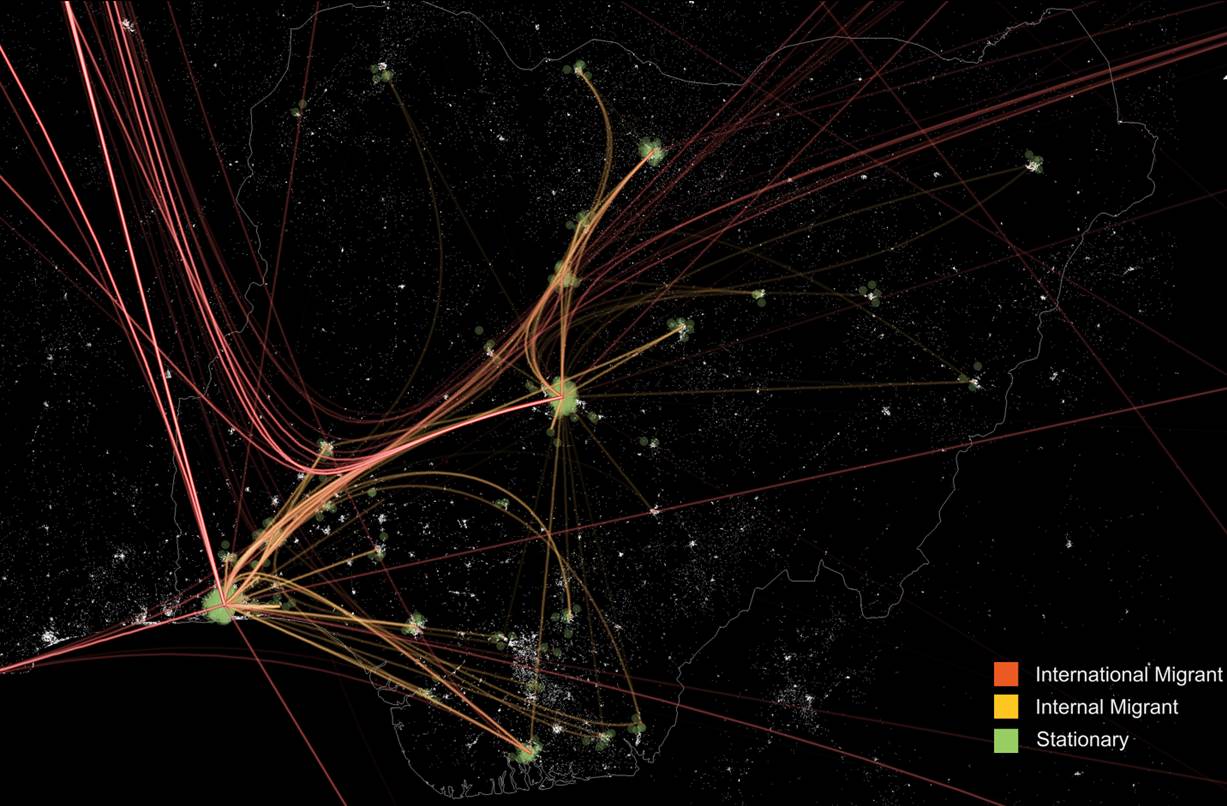

A new study was published by researchers from the German Aerospace Center (DLR) in Oberpfaffenhofen, and the University of Würzburg. This study aimed to improve knowledge of the interests and perspectives of West African migrants by identifying topics which are over- (or under-)represented in their social media posts. Such information, although subjective, can be a valuable complement to the objective information on the land surface that is provided by Earth Observation. In conjunction, the two types of data allow for a better understanding of migrants’ decision making and the factors which influence it. The paper titled “The migrant perspective: Measuring migrants’ movements and interests using geolocated tweets” has just been just published in the Journal of Population, Space and Place by Johannes Mast, Marta Sapena, Martin Mühlbauer, Carolin Biewer and Hannes Taubenböck.
Abstract:
Geolocated social media data hold a hitherto untapped potential for exploring the relationship between user mobility and their interests at a large scale. Using geolocated Twitter data from Nigeria, we provide a feasibility study that demonstrates how the linkage of (1) a trajectory analysis of Twitter users’ geolocation and (2) natural language processing of Twitter users’ text content can reveal information about the interests of migrants. After identifying migrants via a trajectory analysis, we train a language model to automatically detect the topics of the migrants’ tweets. Biases of manual labelling are circumvented by learning community-defined topics from a Nigerian web forum. Results suggest that differences in users’ mobility correlate with varying interests in several topics, most notably religion. We find that Twitter data can be a flexible source for exploring the link between users’ mobility and interests in large-scale analyses of urban populations. The joint use of spatial techniques and text analysis enables migration researchers to (a) study migrant perspectives in greater detail than is possible with census data and (b) at a larger scale than is feasible with interviews. Thereby, it provides a valuable complement to interviews, surveys and censuses, and holds a large potential for further research.
The full paper can be found at: https://doi.org/10.1002/psp.2732 . The study was conducted as part of the projects MIGRAWARE (German Federal Ministry of Education and Research), FPCUP (funded by the European Commission), and Megacities (funded by the Volkswagen Foundation).
This paper is related to other studies of the team in the context of migration in West Africa:
• The Unseen—An Investigative Analysis of Thematic and Spatial Coverage of News on the Ongoing Refugee Crisis in West Africa ( https://ieeexplore.ieee.org/document/10144130 )
• Enhancing Earth Observation of Migration with Insights from Social Media ( https://elib.dlr.de/186635 )
• Integrating multi-source remote sensing data for monitoring urban development in West Africa ( https://doi.org/10.1109/JURSE57346.2023.10144165 )
• Linking remote sensing data and online engagement in flood events in Nigeria ( https://doi.org/10.1109/JURSE57346.2023.10144130 )
The developed migration-detection algorithm used in this work is being released as an open R package. More information to come!