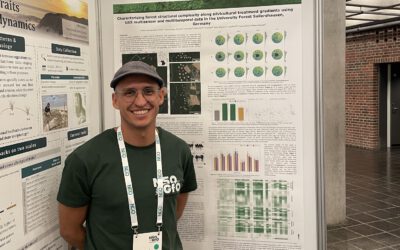
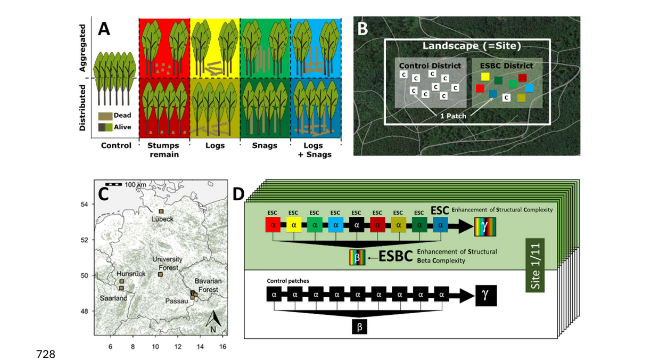

A new peer-reviewed publication investigates how between-patch heterogeneity and old-growth forest attributes influence the structure of beetle metacommunities in temperate forests. The study, led by Dr. Oliver Mitesser from the Biology Department, combines field-based ecological assessment with high-resolution unmanned aerial system (UAS) measurements of forest structure.
Our EORC UAS research group contributed spatially explicit forest structural data that enabled quantitative characterization of canopy complexity and habitat variability across patches. Co-authors from the team include Dr. Mirjana Bevanda, Dr. Jakob Schwalb-Willmann, and Antonio Castaneda-Gomez. By integrating remote sensing with metacommunity ecology, the study advances understanding of how structural legacies of forest management and natural disturbance shape biodiversity patterns.
The findings underscore the ecological relevance of fine-scale structural heterogeneity and demonstrate the value of UAS-derived 3D forest metrics for biodiversity research, monitoring, and conservation planning in temperate ecosystems. The work highlights the importance of interdisciplinary collaboration between ecology and geospatial science in addressing complex questions of habitat structure and species assemblages.
The publication is available here: