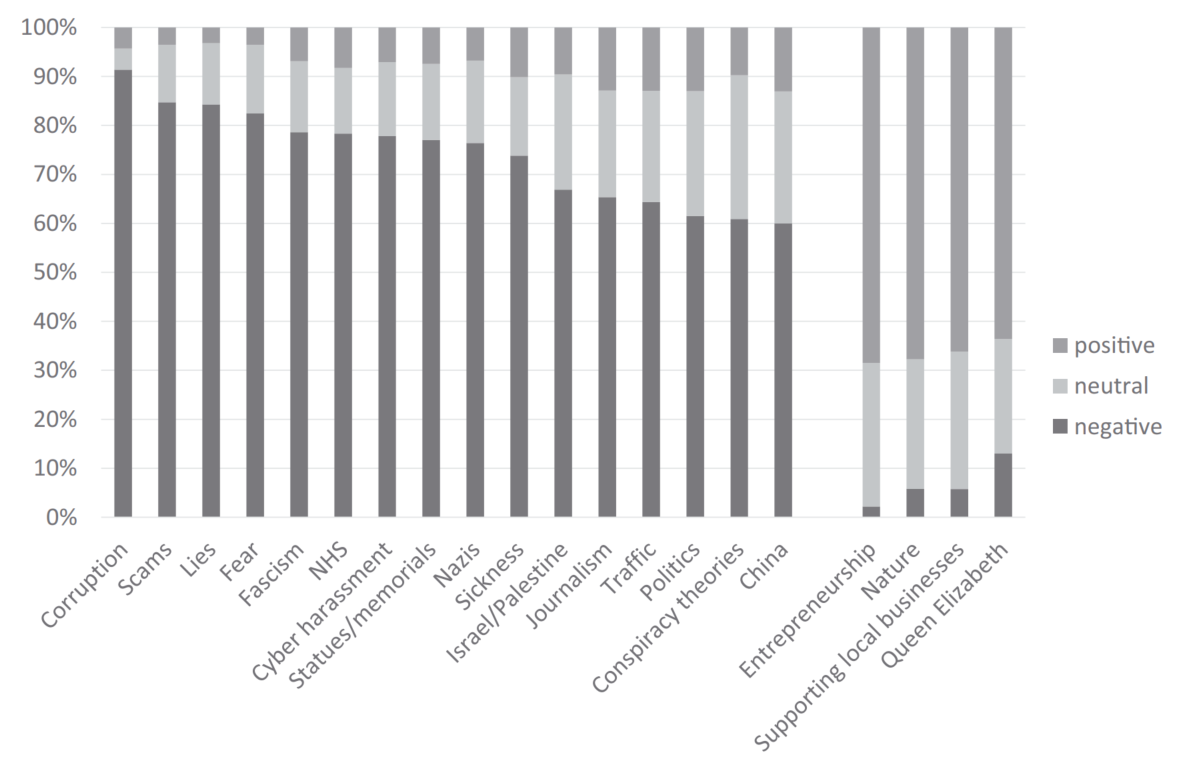

The availability of social media data and tools to (semi-)automatically analyse them has sparked research in various fields to assess human behaviour, opinions and attitudes on a global scale. In a new paper titled “Integrating Corpus Linguistics and NLP Methods to Explore Social Media Discourse from Edinburgh and London“, Twitter data posted during the COVID-19 pandemic have been used to assess emerging topics and evaluate them.
This research was a joint undertaking by researchers from the Geolingual Studies Team (https://www.phil.uni-wuerzburg.de/gls), i.e. the Chair of English Linguistics of the Institute of Modern Languages and our Earth Observation Research Cluster (EORC) of the University of Würzburg as well as the Earth Observation Center (EOC) of the German Aerospace Center (DLR). The study was just published in the Journal ‘Corpus-based Studies across Humanities’ by Lisa Lehnen, Ninja Schulz, Richard Lemoine-Rodríguez, Hannes Taubenböck and Carolin Biewer.
Here is the abstract of the paper: The availability of social media data and tools to (semi-)automatically analyse them has sparked research in various fields to assess human behaviour, opinions and attitudes on a global scale. Besides challenges with data preprocessing to ensure the quality of the database, improving the accuracy of automated classifications, such as topic modelling and sentiment analysis, is frequently discussed in natural language processing (NLP) and beyond. In discourse studies, the interpretability of automated classifications is important for integrating such tools into more fine-grained textual analyses. For instance, the distinction into positive and negative polarity rendered by sentiment analysis constitutes a starting point for assessing human perceptions and opinions, but the mere polarity labels do not necessarily allow for interpreting the meaning of sentiments across topics. To explore this, we use Twitter data from Edinburgh and London posted during the COVID-19 pandemic and assess emerging topics and their evaluation. Focussing on methodological aspects, we integrate corpus-linguistic methods to validate and complement NLP techniques to study urban discourses. This study thus contributes to enhancing the toolkit for corpus-assisted discourse analysis, and, at the same time, underscores the value of linguistic insights for social sciences research.
Read the full article here: https://www.degruyterbrill.com/de/document/doi/10.1515/csh-2025-0026/html
This work is closely related to previous or forthcoming works of the Geolingual Studies team (https://www.phil.uni-wuerzburg.de/gls) – see here for more information:
- Forthcoming book:
- The first edited volume on “Geolingual Studies on Urban Space” will be published by Edinburgh University Press as part of the series New Directions in World Englishes Research in August 2026 – https://edinburghuniversitypress.com/book-geolingual-studies-on-urban-space.html ; https://remote-sensing.org/coming-soon-geolingual-studies-on-urban-space/
- Selected past research studies:
- Online Concerns About Urban Heat: Social Media, Temperature, and Urban Form. https://ieeexplore.ieee.org/document/11075998
- The Relationship Between Urban Morphology and the Citizens’ Social Media Footprints: A case study on Tokyo. https://ieeexplore.ieee.org/document/11076032
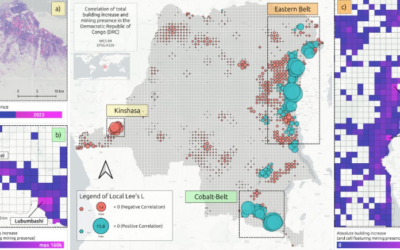
- Africa’s digital urban frontier: Inequality in social media activity between consolidated and newly urbanized areas in Africa https://www.sciencedirect.com/science/article/pii/S0143622825001821
- Geospatiality: the effect of topics on the presence of geolocation in English text data. https://www.tandfonline.com/doi/full/10.1080/13658816.2025.2460051
- The voices of the displaced: mobility and Twitter conversation of migrants of the 2022 Ukraine war. https://www.sciencedirect.com/science/article/pii/S030645732400030X
- The migrant perspective – Measuring migrants’ movements and interests using geolocated tweets. https://onlinelibrary.wiley.com/doi/10.1002/psp.2732
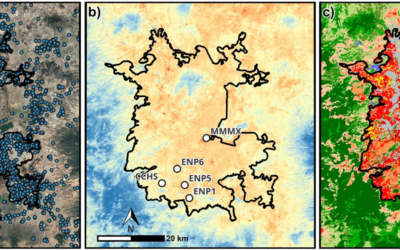
- Can social media data help to understand the socio-spatial heterogeneity of the interests and concerns of urban citizens? A Twitter data assessment for Mexico City. https://link.springer.com/chapter/10.1007/978-3-031-61440-8_10
- The Unseen—An Investigative Analysis of Thematic and Spatial Coverage of News on the Ongoing Refugee Crisis in West Africa. https://ieeexplore.ieee.org/document/10144130