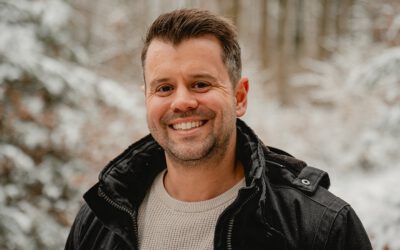

Michael’s the guy you want in front of the class when it’s time to actually open up an image and start segmenting it. At EAGLE he teaches the urban side of things: environmental exposure, pollutants, green space, noise, traffic, air pollution, urban heat islands. And that’s not some random assignment, it’s literally what he does as team leader at DLR DFD GZS too.
He studied geography in Graz, focusing on remote sensing, geoinformatics and human geography, then joined DLR in 2008 for his PhD. That work was about bringing remotely sensed spatial data into empirical social science analysis, done together with the German Institute for Economic Research in Berlin. It’s a pretty good preview of how he operates generally, take a remote sensing method and figure out what question it actually answers for a social scientist or urban planner, instead of treating it as a technical exercise that exists for its own sake.
After Graz and a stint at Joanneum Research, he came to University Würzburg and DLR in 2008 to work on integrating earth observation into social sciences and urban remote sensing. Since 2012 he’s also been lecturing at the University of Graz, teaching Urban Remote Sensing, Advanced Classification and Object-based Classification, so by the time he walks into an EAGLE classroom he’s already taught that material more times than he can probably count. From 2013 to 2022 he worked as a postdoc on urban poverty, urban green spaces and air pollution, and since 2022 he’s been leading the City and Society research group at DLR.
In the EAGLE classroom, his sessions on earth observation for urban environmental exposure, green space, noise, traffic, air pollution and heat islands are a recurring fixture, the kind of hands-on class where students go from raw imagery to meaningful urban objects and you can watch the workflow actually click for them. It’s a deceptively hard thing to teach well. Object-based thinking asks people to stop looking at images pixel by pixel and start thinking in terms of objects and how they relate to each other, and that’s a real shift for a lot of students. Michael’s been teaching exactly that shift for over a decade now.
What comes through in his bio is genuine curiosity about cities, how they grow, how poverty and green space and air quality play out spatially, and that curiosity is clearly part of what makes his classes land. He’s not just demonstrating software. He’s showing students why object-based thinking actually matters for understanding real urban problems.