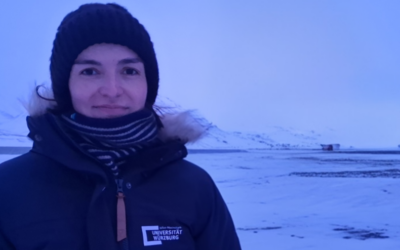
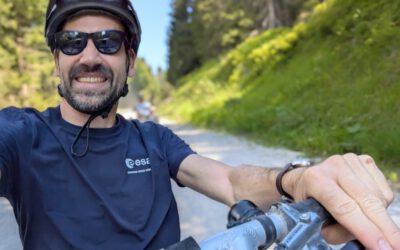
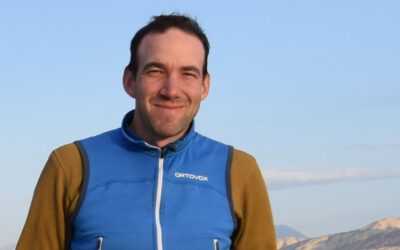
Celia’s the person who got an entire generation of EAGLE students to care about ice they’ll probably never set foot on. She’s a postdoctoral researcher in the “Polar and Mountain Regions” team at DLR, and she teaches the EAGLE course “Earth Observation of Cold Regions”. This intensive block course takes students on a journey through Antarctica, the Arctic, and mountain regions around the world, with a particular focus on the Alps and many hands-on programming exercises.
After studying in Erlangen and Bonn, she did her PhD at the University of Würzburg, where she built a CNN-based algorithm to automatically detect glacier and ice shelf front positions from SAR satellite imagery, applied along the entire Antarctic coastline. That’s a genuinely tricky problem, ice fronts move, fracture and calve in ways that are hard to track manually at continental scale, so getting a deep learning model to do it reliably was no small feat. She defended that thesis in 2021, and the methods she developed there now sit right at the center of what she teaches.
In the EAGLE classroom, her course introduces students to both optical and radar-based methods for monitoring glaciers, ice sheets, sea ice, and polar ecosystems. It covers topics such as ice dynamics, glacier mass balance, snow cover, and permafrost change, and explores how these processes are linked to global climate change. It’s not just theory either, EAGLE students have visited her directly at DLR’s Earth Observation Center in Oberpfaffenhofen where she supervises MSc theses, InnoLabs and internships on topics like the alpine cryosphere’s future under sustained warming, using the Hohe Tauern National Park as a case study for what shrinking snow cover means for mountain infrastructure and alpine huts.
What comes through in her teaching is the same thing that drives her own research, an honest fascination with snow and ice as more than scenery, but as a sensitive, fast-changing system worth tracking carefully. For students who’ve mostly thought about remote sensing in terms of forests, cities or farmland, her course is often their first real introduction to the cryosphere, and by the sound of it, she makes that introduction count.