
The heatwaves of summer 2026 and the associated excess mortality highlight one aspect of the dramatic nature of climate change. Over the years, we have carried out a great deal of research on the topic of ‘urban heat islands’ (see below for related works) – but we have never investigated how residents perceive and communicate heat-related experiences. In a new study titled “From Measured to Experienced Heat: A Multimodal Analysis of Temperature, Urban Form, and Social Media in Mexico City” that is precisely what we have focused on. The paper has just been published in the IEEE Journal of Selected Topics in Applied Earth Observations and Remote Sensing (JSTARS) by Richard Lemoine-Rodríguez, Henri Debray, Carolin Biewer, Luis Inostroza and Hannes Taubenböck. The team of authors is from the Chair of English Linguistics, the Geolingual Studies team and our EORC of the University of Würzburg, the Mendel University in Brno, Czech Republic and the Earth Observation Center (EOC) of the German Aerospace Center (DLR).
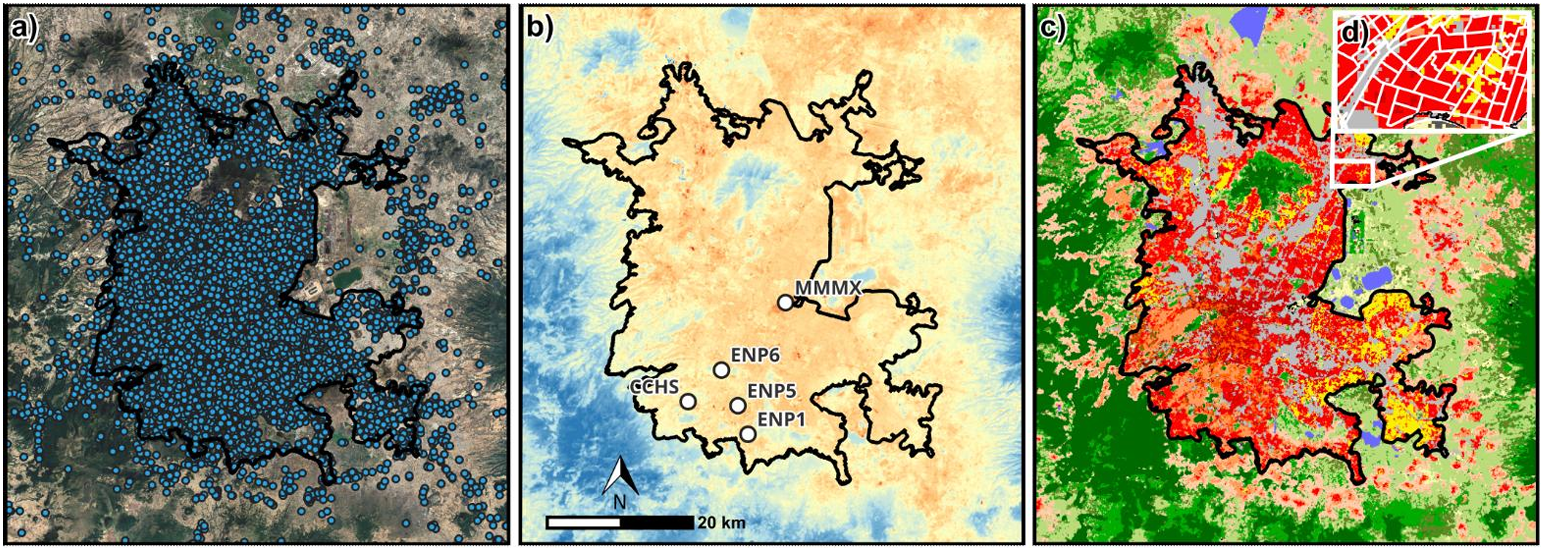
Here is the abstract of the paper: Urban populations face increasing exposure to high temperatures due to climate change. Yet, little is known about how residents perceive and communicate heat-related experiences and whether such expressions vary within cities. This study combines multimodal data to examine relationships between urban heat, related online discussions, socio-demographics, and urban form. We analyze geolocated Twitter posts from Mexico City during 2022, alongside weather station air temperatures, satellite-derived land surface temperature (LST),urban form represented by the local climate zones (LCZ) classification, and census indicators. The volume of heat-related tweets rises exponentially once air temperatures exceed 25°C. In addition, LCZ characterized by higher LST exhibit a greater share of heat-related tweets. Furthermore, LCZ differ significantly in population density, age structure, internet access, and marginalization, indicating that heat-related social media activity reflects socio-thermal contrasts rather than thermal exposure alone. Thematic LLM-assisted analysis of the tweets shows that social media serves as a platform to communicate the challenges faced during periods of high temperatures, including “Health issues/Heat stress”, “Working conditions/clothes”, “Cooling/Air conditioning”, and “Harassment”. These findings show that social media can be used to assess public perceptions and lived challenges associated with urban heat and the built environment. Such insights can inform the design of more human-centered climate adaptation strategies in urban settings.
The open access paper can be downloaded here: https://ieeexplore.ieee.org/document/11668678
For related works of ours on the urban islands effects, we point to the following papers:
- DLR zeigt hohe Hitzebelastung in deutschen Großstädten https://www.dlr.de/de/aktuelles/nachrichten/2025/dlr-zeigt-hohe-hitzebelastung-in-deutschen-grossstaedten
- The world’s largest cities under climate change and their adaptive capacity to rising heat https://www.nature.com/articles/s41598-025-19954-z
- The impact of urban configuration types on urban heat islands, air pollution, CO2 emissions and mortality in Europe https://www.sciencedirect.com/science/article/pii/S2542519624001207
- Exposure to urban heat – Citizen Science and remote sensing for the measurement and modeling of indoor and outdoor temperatures and its influencing factors https://www.sciencedirect.com/science/article/pii/S2212095523001165
- Seasonal and Diurnal Variation of Land Surface Temperature distribution and its Relation to Land Use/Land cover Patterns https://www.mdpi.com/1660-4601/19/19/12738
For related works on urban greening as measure for cooling:
- Beyond public inventories: remote sensing–based assessment of urban tree ecosystem services https://www.sciencedirect.com/science/article/pii/S1618866726001226
- The influence of city size versus urban form on land surface temperature variation and the surface urban heat island effect: A cross-city analysis of German cities https://journals.plos.org/plosone/article?id=10.1371/journal.pone.0340060
- Spatially-optimized urban greening for reduction of population exposure to land surface temperature extremes https://www.nature.com/articles/s41467-023-38596-1
For related works on Geolingual studies on the related topic:
- Online Concerns About Urban Heat: Social Media, Temperature, and Urban Form https://ieeexplore.ieee.org/document/11075998
- Can social media data help to understand the socio-spatial heterogeneity of the interests and concerns of urban citizens? A Twitter data assessment for Mexico City https://link.springer.com/chapter/10.1007/978-3-031-61440-8_10