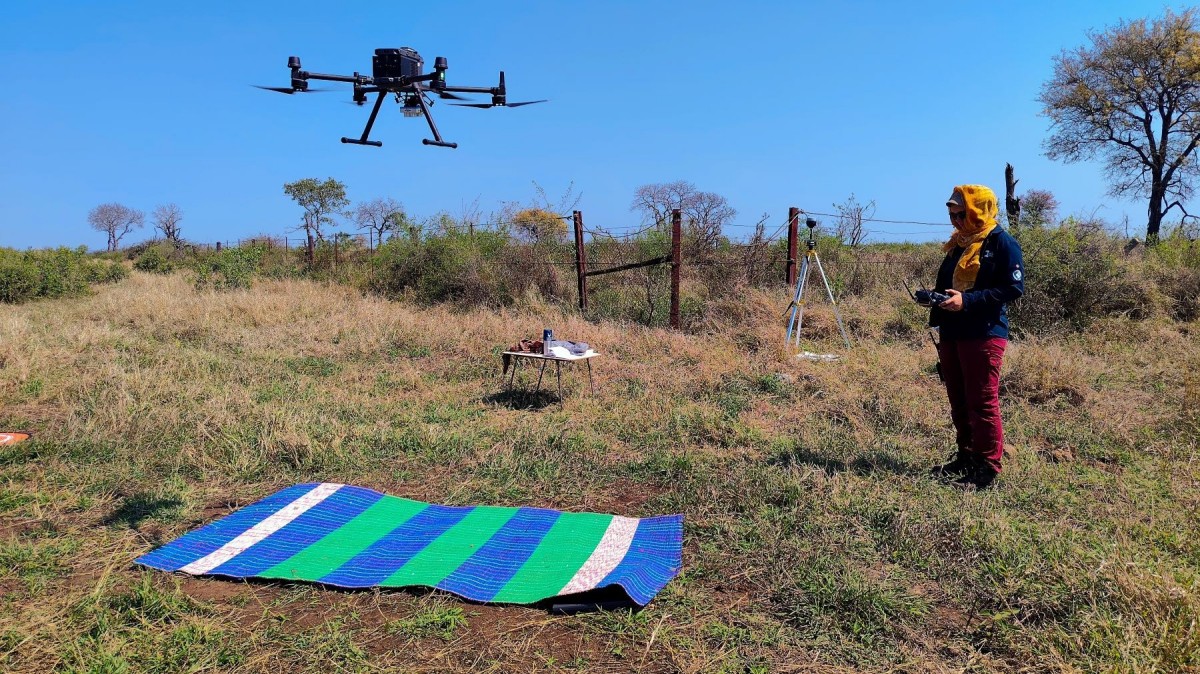

Our PhD candidate Luisa Pflumm is back in Kruger National Park for her third field campaign. Her PhD focuses on how savanna trees respond to combined fire and drought stress for which she is flying UAVs equipped with multispectral and LiDAR sensors.
With this round of multispectral and LiDAR data of the same study areas, the time series is really starting to take shape. Three repeated acquisitions give us a solid basis for looking at change over time rather than just a snapshot. Our EAGLE student Jolien Grafe supported Luisa for 3 weeks during this field campaign.
The South African savanna is characterized by a subtropical climate, with distinct dry and wet seasons. The trees are therefore adapted to certain periods of drought. Due to climate change, however, we’re seeing a shift in rainfall and temperature patterns, more intense rainfall events alongside longer dry periods.
Fire is also a common feature of the savanna and shapes the ecosystem significantly. Here too, plants have developed adaptation strategies and can, for example, resprout quickly after a fire. But how much stress is too much stress?
We can detect both fire and drought stress using remote sensing: vegetation assessment via multispectral and LiDAR data, fire mapping via thermal sensors. This is a promising approach for capturing vegetation response at a fine spatial scale.
The extensive fire campaign during the last dry season in 2025 gives us insights into fire intensity and rate of spread, while LiDAR additionally provides information on fuel mass. This is the reference point against which we can now compare tree responses over the following seasons.
Conditions on the ground this season are a bit unusual: strong rainfall earlier in the year has left the current dry season notably greener and wetter than expected. This will need to be considered when interpreting drought-stress-related signals in this round’s dataset, since the usual dry-season baseline doesn’t quite apply.
Alongside the work, the team also gets to experience the incredible landscape and hospitality of Kruger National Park.
The research is done within the Fire DFG project lead by Mirjana Bevanda and Tobias Ullmann.