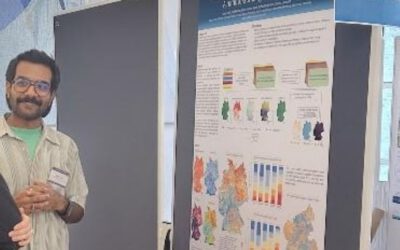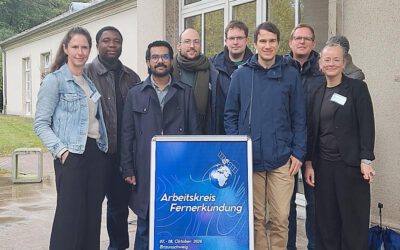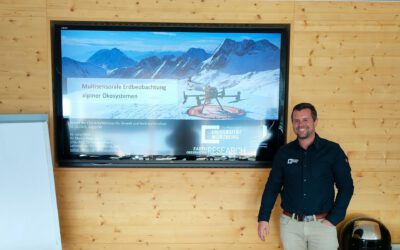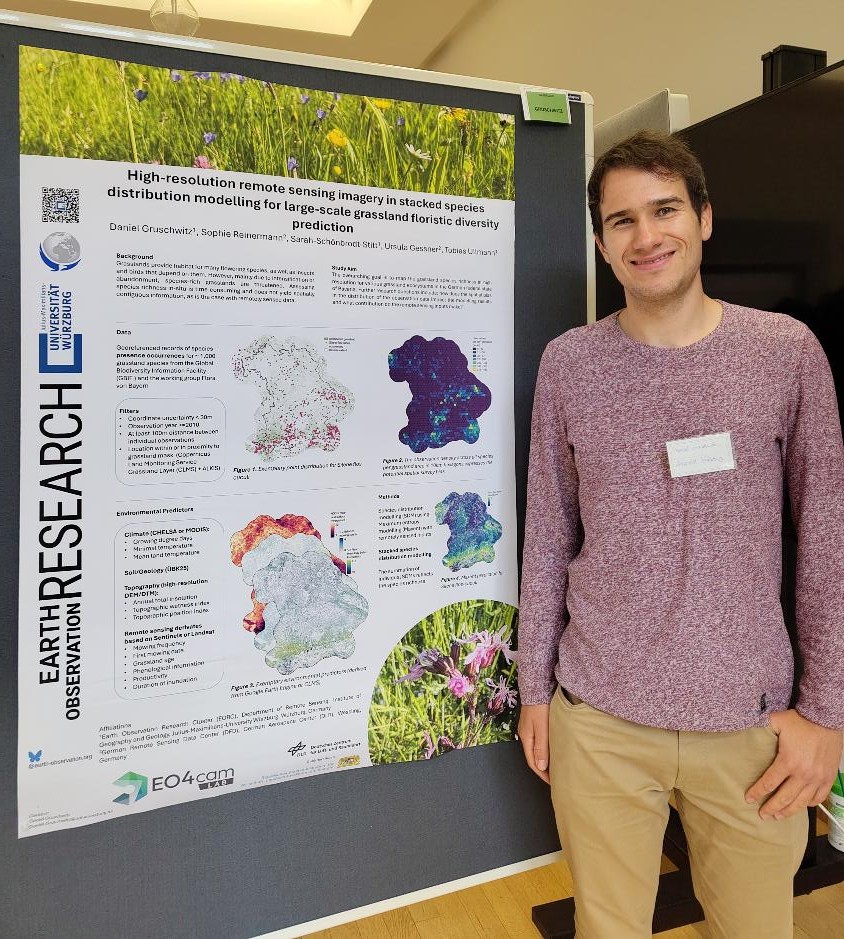

At the 2026 annual meeting of the German Working Group on Remote Sensing (AK Fernerkundung), hosted by the Thünen Institute in Braunschweig, Daniel Gruschwitz from the Earth Observation Research Cluster (EORC) at Julius-Maximilians-Universität Würzburg presented ongoing research on mapping grassland plant diversity across Bavaria.
Species-rich grasslands provide important habitats for flowering plants, insects, and birds, but are increasingly threatened by agricultural intensification and land abandonment. Understanding their spatial distribution and biodiversity is essential for effective conservation and sustainable land management.
The presented research explores how Earth observation and environmental data can contribute to mapping grassland plant species richness across Bavaria. Particular attention is given to the potential of satellite-derived information for improving our understanding of spatial biodiversity patterns and supporting large-scale biodiversity monitoring.
The work highlights the value of combining Earth observation and ecological research to provide spatial information relevant to biodiversity conservation and sustainable grassland management.
The poster, entitled “High-resolution remote sensing imagery in stacked species distribution modelling for large-scale grassland floristic diversity prediction”, was jointly authored by Daniel Gruschwitz (1), Sophie Reinermann (2), Sarah Schönbrodt-Stitt (1), Ursula Gessner (2), and Tobias Ullmann (1).
The research is conducted in collaboration between the (1) Earth Observation Research Cluster (EORC), Julius-Maximilians-Universität Würzburg, and the (2) German Remote Sensing Data Center (DFD), German Aerospace Center (DLR), in the context of the EO4CAM project, funded by the Bavarian State Ministry of Economic Affairs, Regional Development and Energy.
For further information, please visit the AK Fernerkundung 2026 program.