
It was a pleasure to have dinner with Professor Jarugu Narasimha Moorthy, who received an honorary doctorate from the Faculty of Chemistry and Pharmacy in recognition of his achievements. The ceremony took place on 29 September 2026 in the Chemistry Central Building. In 1995, supported by the Alexander von Humboldt Foundation, he joined the Chair of Organic Chemistry II at the University of Würzburg for a year and a half, where, under the supervision of Professor Waldemar Adam, he deepened his expertise in photochemistry. In 2019, upon his appointment as Director of the Indian Institute of Science Education and Research (IISER) Thiruvananthapuram (TVM), he initiated the first cooperation with Würzburg’s Faculty of Chemistry and Pharmacy in 2021: a dual doctoral degree programme for the exchange of doctoral researchers between the two institutions.
Knowing his history not only with the University of Würzburg but also with the city itself, it was exciting for me to talk about his experiences in science. I am grateful that Professor Frank Würthner, Head of the Center for Nanosystems Chemistry and the Chair of Organic Chemistry II at the University of Würzburg, invited me to the award ceremony. And while talking about my upcoming business trip to India with our university’s Vice President for Internationalisation and Alumni, Professor Doris Fischer, she mentioned his name too, describing how, as an alumnus, he has contributed enormously to the lasting partnership between our institutions. This all made me very excited to maybe contact him. Even though my own background, remote sensing, is quite different from his, hearing about Professor Moorthy’s broader experience in science was still very appealing to me.
A few days after Professor Moorthy received the award, I approached him in the Sanderring 2 building as he came down the main hall stairs. He was kind enough to strike up a conversation right away. I remember asking him, “How has Würzburg changed from 1995 to now, over these 31 years?” He answered simply: “Not much.” I then mentioned my upcoming business trip to India, funded through the German Indian Academic Network for Tomorrow (GIANT) 2025–2027 programme by the Deutscher Akademischer Austauschdienst (DAAD). The trip is meant to build collaborations between the University of Würzburg and Indian institutions working in remote sensing and its applications, such as IISER TVM, the National Centre for Biological Sciences (NCBS) in Bengaluru, the Indian Institute of Technology (IIT) Bombay, IIT Indore, and the Space Applications Centre (SAC) in Ahmedabad. He was kind enough to offer his help in making the trip more useful.
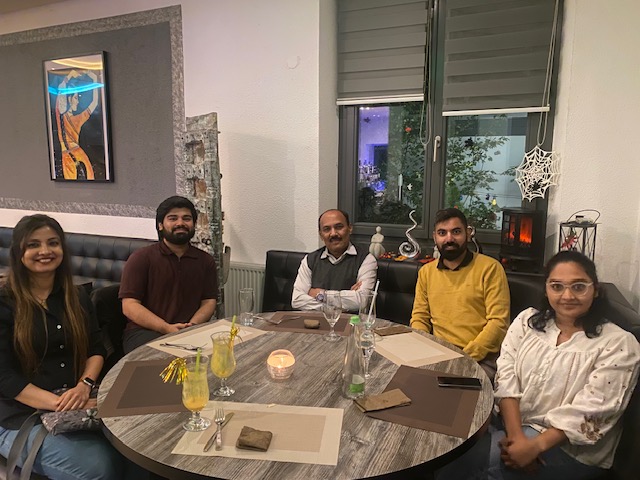
Our conversation kept going, so we decided to continue over dinner at an Indian restaurant. I also invited other Indian postdocs, PhD students, and colleagues from different disciplines across the university, to make the most of this chance to spend time with Professor Moorthy. The group included Sankaranarayanan Srimeenakshi from the Department of Bioinformatics II, Aditya Upadhyaya from the Department of English Linguistics, Pranjal Meel from the Chair of Biochemistry, Sharath Kandala from Energy Management in the Office of the Chancellor, and myself, Maninder Singh Dhillon from the Earth Observation Research Cluster (EORC). Coming from such different disciplines, we were all genuinely excited to meet him, and we even joked with Professor Moorthy that two PhD students got too nervous to join after they learned he had been Director of IISER TVM.
Professor Moorthy spoke with us about many things: our lives, our fields, where we see ourselves in five years, and the role of women in science in India. We also compared working cultures in India and Germany, and talked about how India is growing and opening up to more international collaborations. He was generous enough to help connect me with the Head of the Department of Earth, Environmental and Sustainability Sciences at IISER TVM, which will be a real benefit for the networking side of my upcoming trip.
Overall, it was a reminder that the learning we gain from meeting people isn’t limited to our own professions; it extends to life experience as well. None of us at that table were chemists, and yet we came away having learned so much about so many different aspects of life. The path we are on is full of these kinds of moments, and an evening like this one is a good reminder of how much they can shape our growth. It was a wonderful time spent together.
We wish Professor Moorthy the very best for the future, and thank him again for his time, effort, and openness in meeting with us. I also hope that, just as the Faculty of Chemistry and Pharmacy and IISER TVM now share a strong cooperation, the EORC will soon build something similar with Indian institutions, and that this three-week business trip will serve as the foundation for it.
Thank you to Professor Frank Würthner for the invitation to the award ceremony; to Professor Doris Fischer for her encouraging and motivating reaction on hearing about this trip; to Professor Tobias Ullmann for listening and for his openness to building remote sensing collaborations with Indian institutions; and, last but not least, to Ms Rebekka Steinmann for her willingness to take the lead and make all of these connections possible.
Written by: Maninder Singh Dhillon