
On September 16, 2025, Jean de Dieu Tuyizere will present his Master Thesis on “Utilizing deep learning and Earth Observation data to predict land cover changes in Volcanoes National Park, Rwanda” at 12:00 in seminar room 3, John-Skilton-Str. 4a
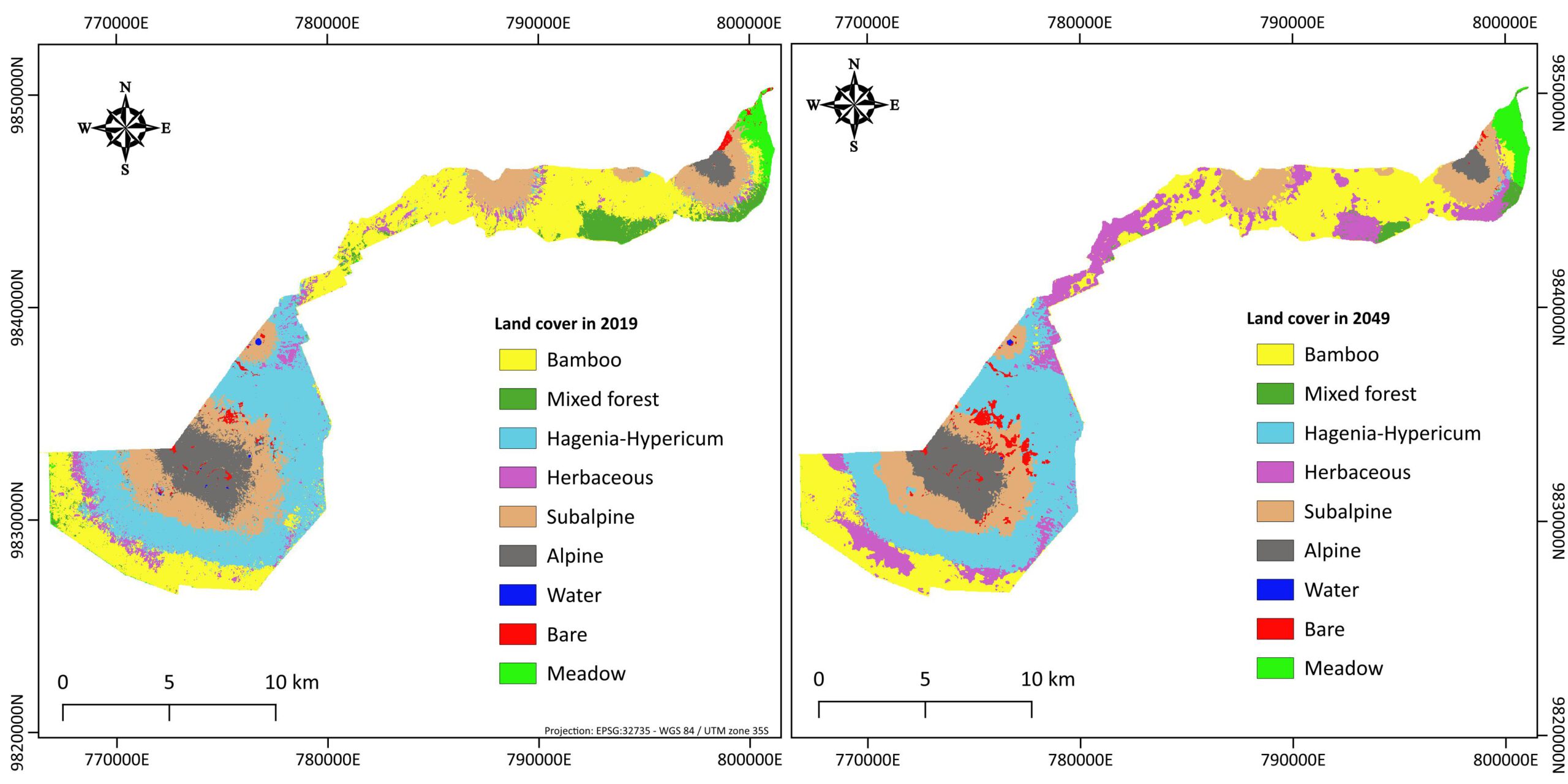
From the abstract: This study modeled land cover change (LCC) inside the Volcanoes National Park (VNP) of Rwanda from 2019 to 2049, addressing a gap in temporal analyses of LCC within the park. Using remote sensing and a hybrid convolutional neural network (Hybrid-CNN) architecture, the research focused on two specific objectives: (1) determining LCC between 2019 and 2024 through land cover (LC) classification maps generated from random forest machine learning in Google Earth Engine, predicting LC maps at five-year intervals up to 2049, and analyzing transitional changes among LC classes across the study period; and (2) examining the relationship between LCC and bioclimatic variables using linear regression. The LCC observed between 2019 and 2024 included decreases in alpine (-2.58%) from 14.80 km² to 14.42 km², subalpine (-1.97%) from 32.47 km² to 31.83 km², bamboo (-9.54%) from 49.63 km² to 44.90 km², mixed forest (-2.9%) from 7.13 km² to 6.92 km², Hagenia-Hypericum (-4.10%) from 45.88 km² to 44.00 km², and water (-3.6%) from 0.141 km² to 0.136 km². Whereas herbaceous cover increased (+89.76%) from 7.53 km² to 14.29 km², and the bare class (+58.03%) from 1.39 km² to 2.20 km². The hybrid-CNN model (overall accuracy of 97.91% with a kappa coefficient of 93.51%) projected further LCC until 2049, with continued decreases in alpine shifting to 13.16 km², bamboo to 43.32 km², mixed forest to 1.96 km², Hagenia-Hypericum to 42.86 km², subalpine to 28.34 km², and water bodies to 0.066 km². The regression line results demonstrated varying degrees of influence that different bioclimatic variables exerted on the predicted area of specific LC classes between 2024 and 2049. The study provided high-resolution predictions and ecological insights vital for conservation planning and supporting park management in this biodiverse region. Continuous LCC monitoring with remote sensing techniques is recommended to adapt management approaches in response to future environmental and climatic changes.
1st supervisor: Dr. Insa Otte
2nd supervisor: Dr. Martin Wegmann
From the abstract: This study modeled land cover change (LCC) inside the Volcanoes National Park (VNP) of Rwanda from 2019 to 2049, addressing a gap in temporal analyses of LCC within the park. Using remote sensing and a hybrid convolutional neural network (Hybrid-CNN) architecture, the research focused on two specific objectives: (1) determining LCC between 2019 and 2024 through land cover (LC) classification maps generated from random forest machine learning in Google Earth Engine, predicting LC maps at five-year intervals up to 2049, and analyzing transitional changes among LC classes across the study period; and (2) examining the relationship between LCC and bioclimatic variables using linear regression. The LCC observed between 2019 and 2024 included decreases in alpine (-2.58%) from 14.80 km² to 14.42 km², subalpine (-1.97%) from 32.47 km² to 31.83 km², bamboo (-9.54%) from 49.63 km² to 44.90 km², mixed forest (-2.9%) from 7.13 km² to 6.92 km², Hagenia-Hypericum (-4.10%) from 45.88 km² to 44.00 km², and water (-3.6%) from 0.141 km² to 0.136 km². Whereas herbaceous cover increased (+89.76%) from 7.53 km² to 14.29 km², and the bare class (+58.03%) from 1.39 km² to 2.20 km². The hybrid-CNN model (overall accuracy of 97.91% with a kappa coefficient of 93.51%) projected further LCC until 2049, with continued decreases in alpine shifting to 13.16 km², bamboo to 43.32 km², mixed forest to 1.96 km², Hagenia-Hypericum to 42.86 km², subalpine to 28.34 km², and water bodies to 0.066 km². The regression line results demonstrated varying degrees of influence that different bioclimatic variables exerted on the predicted area of specific LC classes between 2024 and 2049. The study provided high-resolution predictions and ecological insights vital for conservation planning and supporting park management in this biodiverse region. Continuous LCC monitoring with remote sensing techniques is recommended to adapt management approaches in response to future environmental and climatic changes.
1st supervisor: Dr. Insa Otte
2nd supervisor: Dr. Martin Wegmann