
In her MSc thesis Svenja Dobelmann (now University of Applied Science and Arts Göttingen) explored how wildlife conservation can align with the provision of ecosystem services—what the Intergovernmental Science-Policy Platform on Biodiversity and Ecosystem Services (IPBES) calls Nature’s Contributions to People (NCP). In cooperation with colleagues from University of Halle / Wittenberg and the EORC, she focused on the European wildcat (Felis silvestris silvestris) as a keystone and umbrella species in German protected forests.
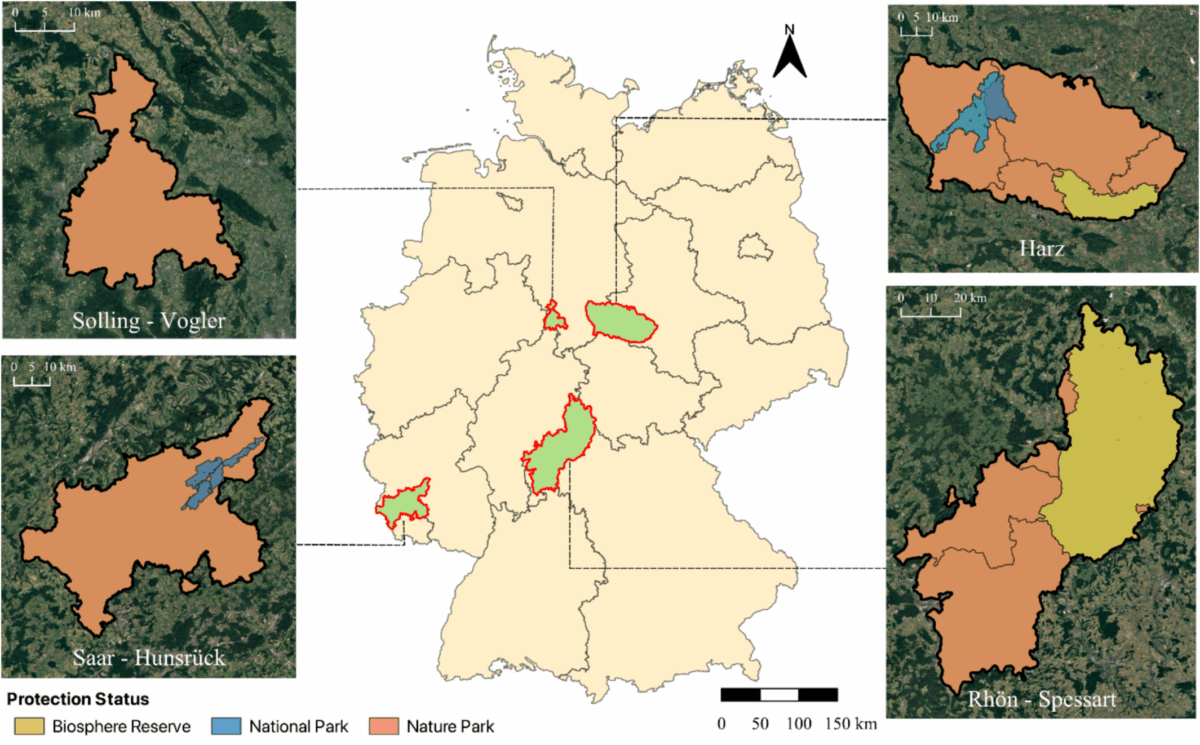
A species distribution model (SDM) has been developed to identify suitable habitats for the European wildcat across four forested regions in Germany. Using remote sensing data and statistical modeling, we assessed how these habitats overlap with four key NCP: carbon sequestration, water retention, timber potential, and recreational value. We also compared NCP supply across different protection levels—national parks, biosphere reserves, and nature parks.
Biodiversity and ecosystem services are often treated as separate conservation goals. Our study bridges this gap by showing how protecting a legally protected species can simultaneously support human well-being. Understanding these synergies is crucial for designing multifunctional landscapes that benefit both nature and people.
The developed model revealed that wildcats prefer structurally complex, densely forested areas far from urban infrastructure but close to agricultural land. These habitats showed a strong synergy with timber potential and moderate associations with other NCP. Importantly, we found no significant trade-offs between wildcat conservation and human-related services like recreation. National parks consistently provided higher levels of NCP, especially for water retention and recreation, compared to biosphere reserves and nature parks.
Protecting wildcat habitats not only supports biodiversity but also enhances ecosystem services. This integrated approach offers a compelling case for expanding conservation zones and adopting wildlife-centered strategies in forest management.
Here’s the link to the publication: https://www.sciencedirect.com/science/article/pii/S0006320725005439?via%3Dihub