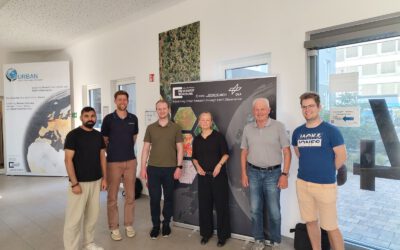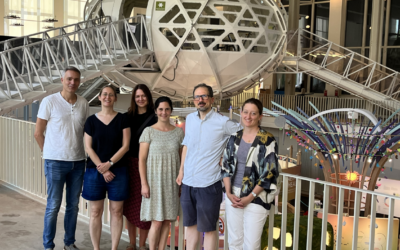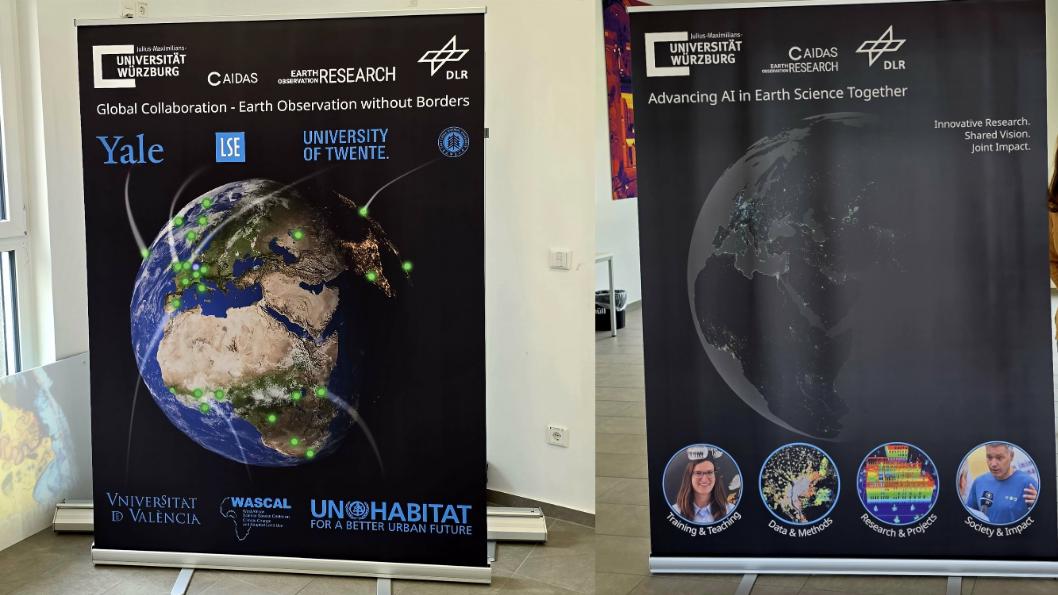

Remote sensing thrives on collaboration as shown (by a few selected ones) on our most recent roll-up. Many of today’s most pressing urban and environmental challenges—rapid urbanization, climate change, landcover change, migration, inequality, and economic development—transcend national borders. Addressing them requires international scientific partnerships that combine expertise in Earth observation, urban science, data analytics, and policy.
Over the past years, our team at the University of Würzburg and the DLR-DFD has built strong collaborations with leading international institutions. These partnerships combine satellite-based Earth observation, deep learning, social media analytics, and urban theory to better understand how cities and the environment evolve across the globe.
Below we highlight some of our key partner institutions and the research that connects our research communities.
Collaboration with Yale University
Our cooperation with Yale University focuses on the intersection of urbanization, socio-economic development, and remote sensing. Together with colleagues including Karen C. Seto, our teams explore how satellite data and new computational methods can reveal previously hidden relationships between urban form, economic activity, and social dynamics.
Recent joint research includes work on deep learning fusion of multi-source remote sensing data for sub-national GDP estimation, combining satellite observations with advanced machine learning to estimate economic development at unprecedented spatial detail. Another research direction investigates how urban morphology relates to citizens’ social media behavior, integrating Earth observation with digital traces to better understand urban life.
Our teams also collaborate in mentoring young scientists. For example, the doctoral work of De-Cyuan Jheng is jointly supervised within this partnership, strengthening academic exchange between institutions.
Collaboration with the London School of Economics
Our collaboration with London School of Economics and Political Science, particularly the LSE Cities initiative, connects remote sensing science with urban governance and policy research.
Scientific exchange has taken many forms: visiting research stays, invited lectures, and keynote presentations. These include a research stay and lecture by Hannes Taubenböck in London, as well as a keynote presentation by Philipp Rode in Würzburg.
Current joint research focuses on urban governance and youth participation in intermediary cities in Colombia, combining digital data and urban studies perspectives to explore how young people engage with governance in rapidly growing cities.
Collaboration with the University of Twente
Our collaboration with the University of Twente builds on a long-standing partnership in urban remote sensing.
Together with Monika Kuffer, our teams contribute to shaping the scientific agenda of the field through leadership roles in the Joint Urban Remote Sensing Event (JURSE), one of the major global conferences on urban Earth observation.
Beyond conference leadership, our collaboration includes joint editorial work on special issues in the IEEE Journal of Selected Topics in Applied Earth Observations and Remote Sensing and research on urban inequality, slum mapping, and environmental challenges in cities worldwide. These projects highlight the potential of satellite data to identify and analyze socio-spatial disparities across urban environments.
Collaboration with East China Normal University
Together with colleagues at East China Normal University, we investigate the dynamics of China’s rapid urban transformation.
Our joint studies examine phenomena such as “ghost cities” and underused housing developments, exploring how large-scale urban expansion can lead to mismatches between built infrastructure and population dynamics. Using high-resolution satellite imagery and urban analytics, these studies reveal patterns of housing vacancy, urban hierarchy, and spatial development across Chinese cities.
This collaboration highlights how Earth observation can provide critical insights into one of the most dramatic urbanization processes of the 21st century.
Collaboration with the University of Valencia
Work with the University of Valencia focuses on Earth observation applications for environmental risk and urban expansion monitoring.
Recent research includes cloud-based mapping of urban growth in African cities using Sentinel satellite data, as well as data-driven flood susceptibility mapping in Nigeria. These studies demonstrate how accessible Earth observation data and cloud computing platforms can empower researchers and practitioners to monitor urban change and natural hazards at scale.
Collaboration with WASCAL
Through collaboration with West African Science Service Centre on Climate Change and Adapted Land Use, our work addresses climate, migration, and urban development challenges in West Africa.
Joint studies examine topics such as migration dynamics, refugee settlement structures, rural industrialization, and the role of digital data in understanding urban inequalities. Combining satellite data, social media analysis, and field research helps uncover socio-economic dynamics that are often difficult to observe using traditional data sources.
Collaboration with UN-Habitat
Finally, our research contributes to global urban policy through scientific exchange with UN-Habitat. In particular, we collaborate with experts such as Dennis Mwanka in discussions about global urbanization and the use of Earth observation for monitoring sustainable urban development.
These exchanges ensure that scientific insights from remote sensing research can inform international policy debates and support evidence-based urban planning.
Remote Sensing as a Bridge Between Disciplines and Regions
Across all these partnerships, one theme remains constant: remote sensing enables new ways to understand cities. By integrating satellite data with artificial intelligence, socio-economic indicators, and digital traces, researchers can explore urban dynamics from local neighborhoods to the global scale.
International collaborations such as these not only advance scientific knowledge—they also build bridges between disciplines, institutions, and continents. As cities continue to grow and transform, such partnerships will remain essential for understanding and shaping the urban future.