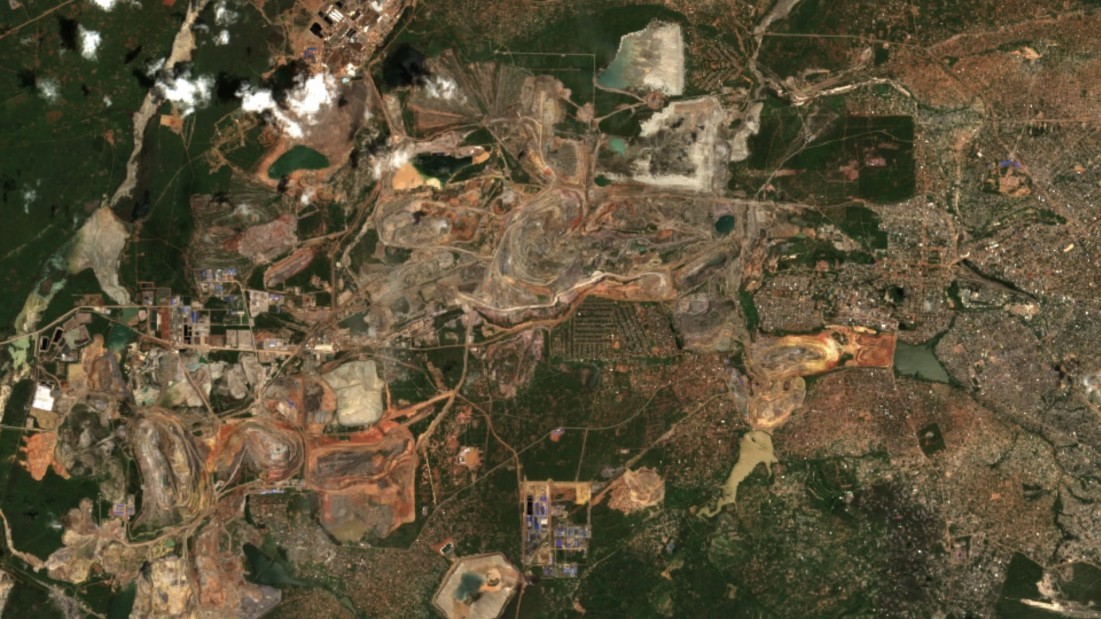

In a newly launched research project funded by the KSB Foundation, we focus on the automated identification of mining areas based on remote sensing data. The aim is to systematically detect large-scale mining activities and to track their spatial and temporal development.
Building on this, the project seeks to quantify the temporal dynamics of mining sites and the associated environmental changes using model-based approaches. This includes, for example, estimates of water consumption, amounts of extracted ore, and other indicators related to land surface change over time.
A particular focus is placed on cobalt, a metal that is essential for the energy transition and is predominantly mined in the southern part of the Democratic Republic of the Congo (DRC). Despite its growing global importance, the environmental and societal impacts of cobalt mining are still insufficiently quantified at larger spatial scales.
In addition to mining activities themselves, the project also addresses settlement dynamics in the vicinity of mining areas. The region around Kolwezi provides a striking example of the close relationship between the expansion of mining areas and surrounding settlement development. Characterizing and quantifying these interactions represents a key component of the project.
By combining remote sensing, spatial analysis, and modeling, the project aims to contribute to a better understanding of mining-related dynamics and to provide a data-driven basis for future environmental and sustainability assessments.