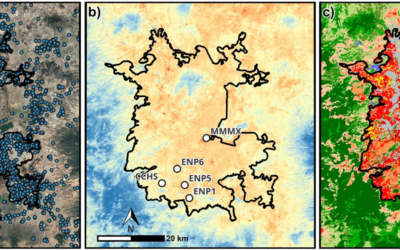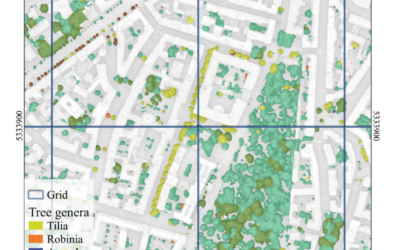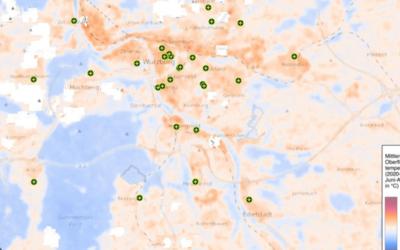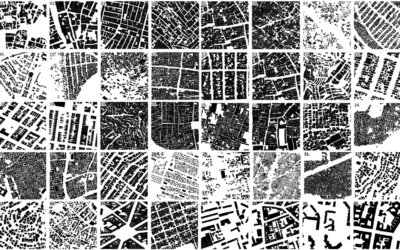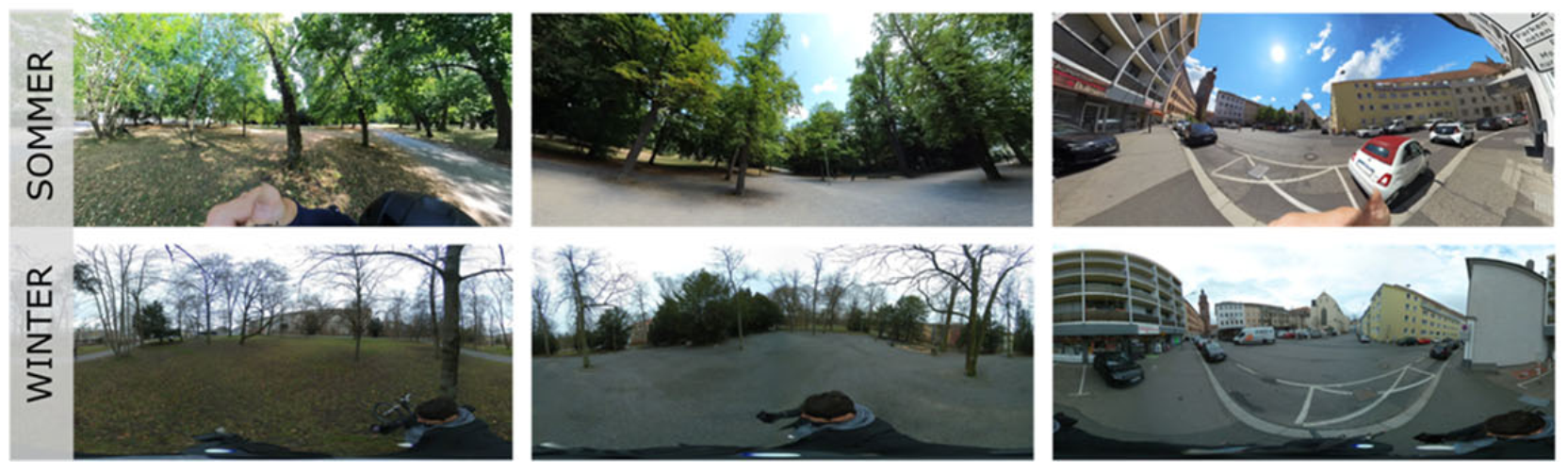

The acoustic perception of urban environments contributes a lot to well-being in cities. In a new publication titled “Der Einfluss morphologischer und ökologischer Variablen auf die menschliche Wahrnehmung der Klanglandschaft in städtischen Gebieten in Würzburg, Deutschland [engl. The influence of morphological and ecological variables on human perception of the soundscape in urban areas in Würzburg, Germany]”, the influence of morphological and ecological parameters, such as tree diversity, building density and open spaces, on the acoustic perception of urban environments was investigated.
This research was a joint undertaking by researchers from social geography of the University of Würzburg and our Earth Observation Research Cluster (EORC) of the University of Würzburg and the Earth Observation Center (EOC) of the German Aerospace Center (DLR). The study was just published in the Journal ‘Standort’ by Nils Karges, Andrea Sofía García de León, Antonio J. Castañeda-Gómez, Tobias Ullmann, Hannes Taubenböck and Jürgen Rauh.
Here is the abstract of the paper: Urban green spaces are key interfaces between the built environment and nature, and influence biodiversity, climate regulation and human well-being through complex ecological and sensory interactions. This study investigates the influence of morphological and ecological parameters, such as tree diversity, building density and open spaces, on the acoustic perception of urban environments. Data were collected between February and July 2024 in Würzburg, Germany, in both park landscapes and more urbanised areas. OpenStreetMap and tree cadastre data were used to evaluate metrics such as tree diversity, species richness and urban morphological attributes. Perceptual data on pleasantness and eventfulness were collected through interviews and surveys. The results demonstrate that parks with greater tree variety, lower building and people density, and more open spaces are perceived as more pleasant, whereas densely built-up areas are considered noisier and more stressful. This highlights the necessity of better integration of soundscape planning into urban development.
Read the full article here: https://link.springer.com/article/10.1007/s00548-026-01044-5?utm_source=rct_congratemailt&utm_medium=email&utm_campaign=oa_20260608&utm_content=10.1007/s00548-026-01044-5
This work is closely related to previous works on the acoustic environments and soundscapes – see here for more information:
- Co-occurrence network analysis of urban acoustic environments: Structural archetypes and perceived quality https://www.sciencedirect.com/science/article/pii/S0198971526000396
- Urban contexts: A Geospatial Approach to Identifying In-Situ Measurement Sites for Urban Acoustic Environments https://www.sciencedirect.com/science/article/pii/S0301479725018778
- Soundscapes on edge – The real-time machine learning approach for measuring Soundscapes on resource-constrained devices https://elib.dlr.de/190129/
- National Road Traffic Noise Mapping with Ensemble Learning and Multimodal Geodata https://www.sciencedirect.com/science/article/pii/S1361920925004730
- Pixels, Chisels and Contours – Technical variations in European road traffic noise exposure maps https://www.sciencedirect.com/science/article/pii/S0301479725014513
- Predicting traffic noise using land use regression – A scalable approach https://www.nature.com/articles/s41370-021-00355-z
- Europäische Lärmkarten – Methodik und Bewertung im Kontext überregionaler Umweltgerechtigkeitsstudien https://elib.dlr.de/135117/
- Using CNNs on Sentinel-2 data for noise modelling https://ieeexplore.ieee.org/document/10144160
- 2000 land-use regressions for road traffic noise predictions – how sample selection affects extrapolation weights https://elib.dlr.de/187661/1/STAAB-etal-2022_Proceedings_A04.pdf