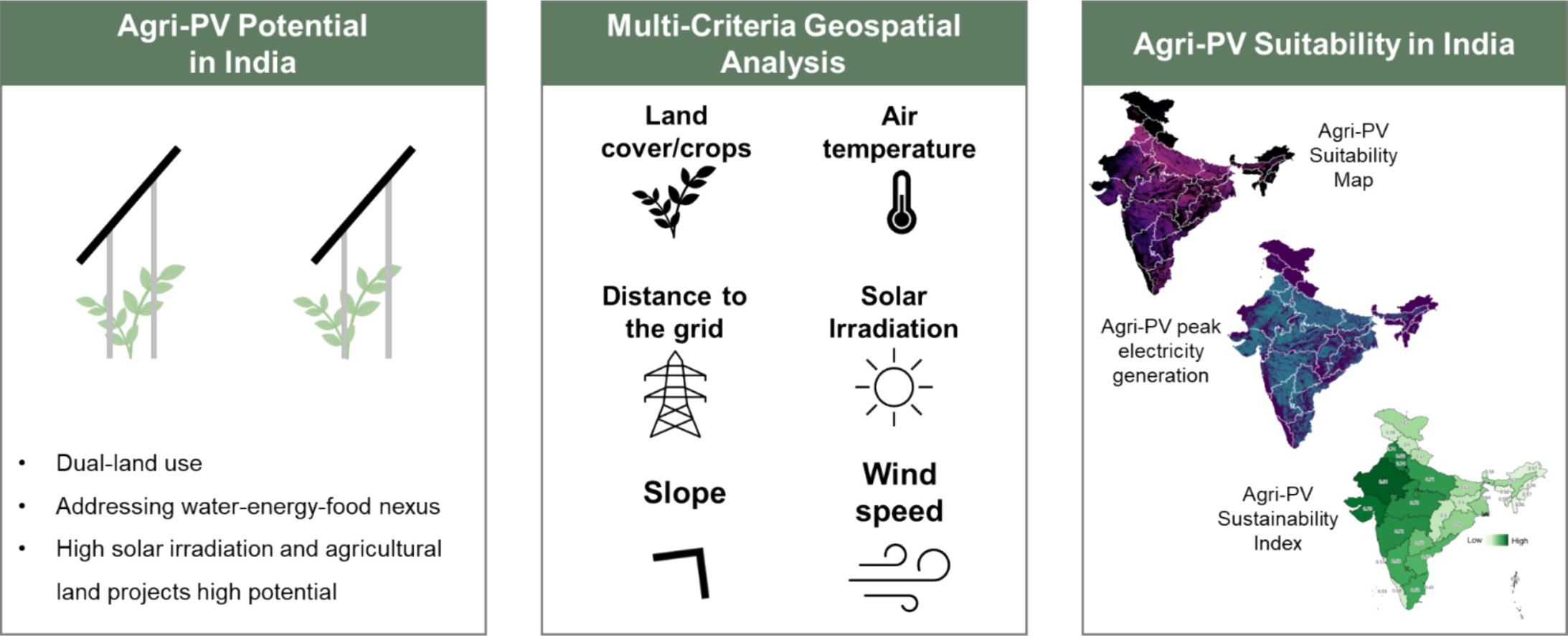

For this study, Ingolstadt Technical University (THI) and Earth Observation Research Cluster at the University of Würzburg teamed up to map the potential for agri-photovoltaic across entire India. This technology has the potential to jointly adress Indias rising energy demand, water resource challenges and agricultural pressures. The EORC contributed with a nationwide mapping of agri-photovoltaic suitability combining multiple geospatial datasets in an innovative fuzzy logic approach. The paper with the title “Agri-photovoltaics in India: Geospatial suitability for sustainable water–energy–food nexus solutions” has been authored jointly by Kedar Mehta from THI and Florian Betz from EORC.
Here is the abstract of the paper: Agri-Photovoltaics or Agri-PV offers a strategic opportunity for India to jointly address rising energy demand, water scarcity, and agricultural pressures within the Water–Energy–Food nexus. This study develops the novel integrated, nationwide framework combining (i) a GIS-based technical suitability analysis, (ii) state-wise Agri-PV electricity-generation potential, and (iii) a composite sustainability assessment. Technical suitability was mapped using datasets on land cover, solar irradiation, slope, temperature, wind speed, and grid proximity, resulting in suitability values ranging from 0.35 to 0.95. The highest suitability values occur in Rajasthan (0.95), Gujarat (0.93), Haryana (0.82), Punjab (0.80), and Madhya Pradesh (~0.78–0.80), while the northeastern and Himalayan states exhibit the lowest values due to steep terrain and high rainfall. Using technically suitable agricultural land and state-specific solar yields, the estimated Agri-PV electricity-generation potential exceeds 4000 GWh/GWp in Uttar Pradesh, Maharashtra, Rajasthan, and Madhya Pradesh. To integrate broader feasibility factors, socio-economic and water-resource indicators were combined with technical suitability to develop the Agri-PV Sustainability Potential Index, which ranges from 0.53 to 0.81. Rajasthan (0.81), Gujarat (0.79), Punjab (0.74), Haryana (0.74), Madhya Pradesh (0.72), and Maharashtra (0.72) rank highest. This framework provides a robust, policy-relevant foundation for guiding Agri-PV deployment and supporting India’s clean-energy and climate-resilience goals. The findings also contribute to advancing India’s clean-energy and climate-resilience goals, consistent with the Sustainable Development Goals 2, 6, 7, and 13.
The full-text is available here doi.org/10.1016/j.esd.2025.101915
Here is the abstract of the paper: Agri-Photovoltaics or Agri-PV offers a strategic opportunity for India to jointly address rising energy demand, water scarcity, and agricultural pressures within the Water–Energy–Food nexus. This study develops the novel integrated, nationwide framework combining (i) a GIS-based technical suitability analysis, (ii) state-wise Agri-PV electricity-generation potential, and (iii) a composite sustainability assessment. Technical suitability was mapped using datasets on land cover, solar irradiation, slope, temperature, wind speed, and grid proximity, resulting in suitability values ranging from 0.35 to 0.95. The highest suitability values occur in Rajasthan (0.95), Gujarat (0.93), Haryana (0.82), Punjab (0.80), and Madhya Pradesh (~0.78–0.80), while the northeastern and Himalayan states exhibit the lowest values due to steep terrain and high rainfall. Using technically suitable agricultural land and state-specific solar yields, the estimated Agri-PV electricity-generation potential exceeds 4000 GWh/GWp in Uttar Pradesh, Maharashtra, Rajasthan, and Madhya Pradesh. To integrate broader feasibility factors, socio-economic and water-resource indicators were combined with technical suitability to develop the Agri-PV Sustainability Potential Index, which ranges from 0.53 to 0.81. Rajasthan (0.81), Gujarat (0.79), Punjab (0.74), Haryana (0.74), Madhya Pradesh (0.72), and Maharashtra (0.72) rank highest. This framework provides a robust, policy-relevant foundation for guiding Agri-PV deployment and supporting India’s clean-energy and climate-resilience goals. The findings also contribute to advancing India’s clean-energy and climate-resilience goals, consistent with the Sustainable Development Goals 2, 6, 7, and 13.
The full-text is available here doi.org/10.1016/j.esd.2025.101915