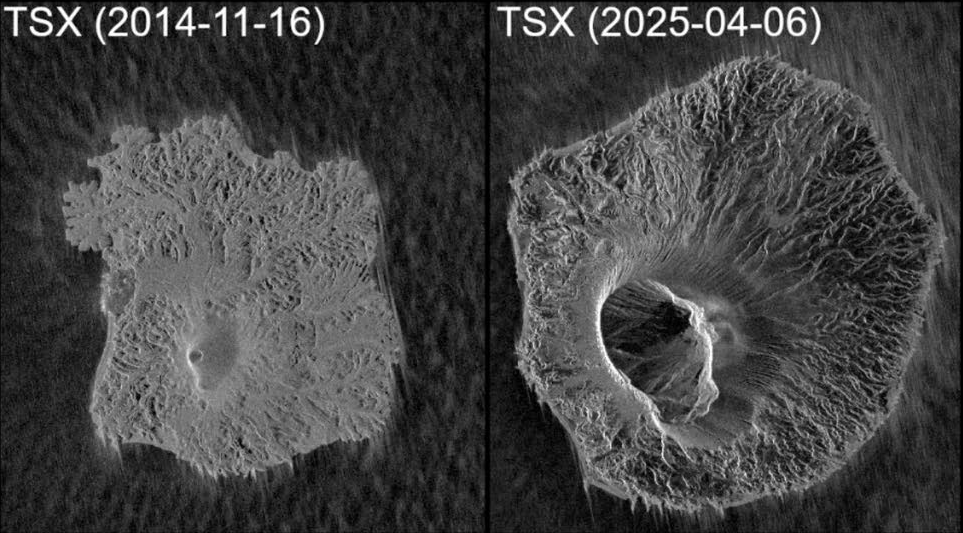

Most volcanic activity is taking place in the oceans. Since the famous eruption of Surtsey (Iceland) in 1963, at least another 23 volcanic islands have appeared. In a new publication titled “Growth and erosion of volcanic islands since 1963 analyzed by multi‑sensor satellite data and historical records”, growth and erosion rates of these volcanic edifices have been analyzed based on satellite data.
This research was a joint undertaking by researchers from the Earth Observation Center (EOC) of the German Aerospace Center (DLR), the University of Alaska Fairbanks, the Alaska Volcano Observatory in Anchorage, the Ludwig-Maximilians-Universität (LMU) in Munich, the National Research Council in Potenza, the Politecnico Di Milano, the GFZ Helmholtz Centre for Geosciences, Potsdam and our Earth Observation Research Cluster (EORC) of the University of Würzburg. The study was just published in the Journal ‘Bulletin of Volcanology’ by Simon Plank, Ronni Grapenthin, Hannah R. Dietterich, Ulrich Kueppers, Francesco Marchese, Nicola Pergola, Emanuele Ciancia, Nicola Genzano, Franz J. Meyer, Sandro Martinis, Hannes Taubenböck, Tobias Ullmann and Thomas R. Walter.
Here is the Abstract of the paper: Most volcanic activity is taking place in the oceans. Depending on water depth, eruption recurrence times and volumes, a new island can form. The power of erosional forces, the type of erupted material and the efficiency of secondary processes determine the island’s lifetime. Since the famous eruption of Surtsey (Iceland) in 1963, at least another 23 volcanic islands have appeared. Some islands remained intact for years or decades, whereas others disappeared within just weeks or months. In this study, we analyzed satellite data to determine growth and erosion rates of the volcanic edifices related to these 24 islands. We combined multi-sensor (optical, thermal, radar) satellite data time series with information from literature and the Global Volcanism Program database. We developed a comprehensive dataset, including 19 parameters, on the islands’ lifetime, shape, area, volume, eruption style and duration, environmental conditions, development of sedimentary deposits, and the geomorphic evolution of the island over time. Our dataset is available in a database format. This database allows us to test eight hypotheses about factors influencing the islands’ lifetime. Our results show that instead of one single critical factor, a combination of different factors influences the life history of volcanic islands. For instance, we show that larger islands do not necessarily live longer. The mechanical properties of the eruption products affect the island’s structural integrity. Irrespective of the material, a minimum initial area of around 50,000 m2 seems to be a reasonable threshold to give the island a chance to exist longer.
Read the full article here: https://link.springer.com/article/10.1007/s00445-026-01987-5
This work is closely related to previous works on the monitoring and analysis of volcanic activity using Earth observation data – see here for more information:
- Erosion controls vent migration – Home Reef (Tonga) 2022-2024 evolution process analyzed from space https://www.nature.com/articles/s41598-025-95197-2
- https://remote-sensing.org/dr-simon-plank-interviewed-by-nasa-earth-observatory/
- https://remote-sensing.org/presentation-at-the-largest-volcano-conference/
- https://remote-sensing.org/massive-landslide-in-alaska-triggered-tsunami-supporting-the-alaska-earthquake-center/