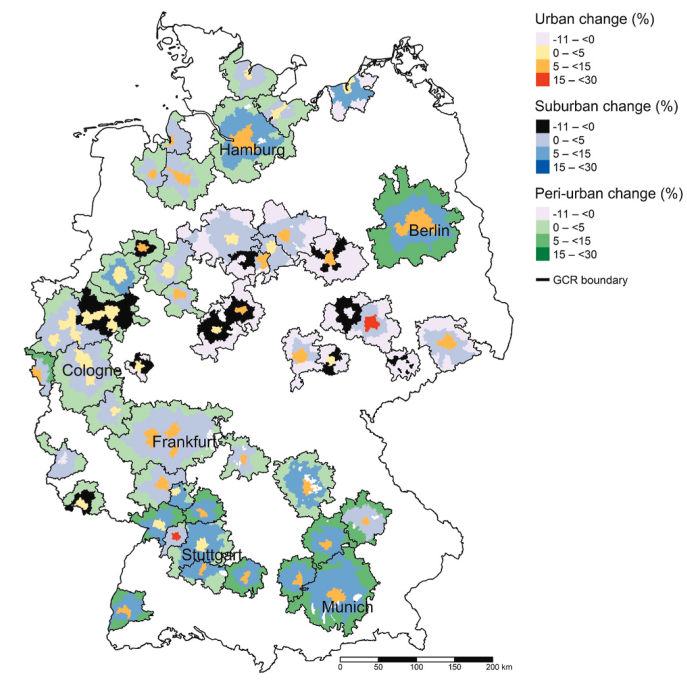

Researchers from the Federal Institute for Population Research (BiB), the Earth Observation Center (EOC) of the German Aerospace Center (DLR), the Department of Sociology and Social Psychology (DSS) of the University of Cologne, the Demographic Research Centre of the Vytautas Magnus University, and our Earth Observation Research Cluster (EORC) of the University of Würzburg teamed up for a study whether Germany is experiencing urban or suburban growth. The paper titled “Is Germany experiencing urban or suburban growth? Contrasting long-standing and novel urban gradient classifications” was just published in the journal Applied Geography by Tamilwai J. Kolowa, Matthias Weigand, Ines Standfuß, Sebastian Klüsener, Nik Lomax, and Hannes Taubenböck.
Here is the abstract of the paper: Understanding population shifts along urban-rural gradients is crucial for informed decision-making in sustainable spatial planning. Empirical accounts of urbanization and suburbanization rely on classification choices, typically derived from administrative units. Recently, novel classification approaches based on remote sensing and high-resolution population data have gained relevance. This trend, driven by methodological advancements, raises the question of whether these new approaches yield similar or different results in comparative analyses along urban-rural gradients. Our paper explores how classification choices affect assessments of population trends along the urban-rural gradient at both the national and subnational regional scales. We contrast three urban gradient classifications to analyze population change in 50 German metropolitan regions from 2011 to 2022. Results indicate that, at the national scale, observed trends in urban, suburban, and peri-urban areas are consistent across all classifications. For Germany, we find that urban areas have registered higher growth rates than suburban and peri-urban areas across all classifications. However, at the regional scale, observed trends partially depend on classification choices, suggesting that regional findings are particularly sensitive to the chosen classification scheme. The methodological framework presented here can also be applied to other geographical contexts for which similar data are available.
Here is the link to the full paper: https://www.sciencedirect.com/science/article/pii/S0143622825002747
This research is related to previous works on the degree of urbanization, settlement types and demographics in Germany, see e.g.:
- https://www.sciencedirect.com/science/article/pii/S0198971522000746
- https://ieeexplore.ieee.org/abstract/document/11076045
- https://ieeexplore.ieee.org/document/10144133
- https://elib.dlr.de/195853/1/bbsr-online-18-2023_Taubenb%C3%B6ck%20et%20al.pdf