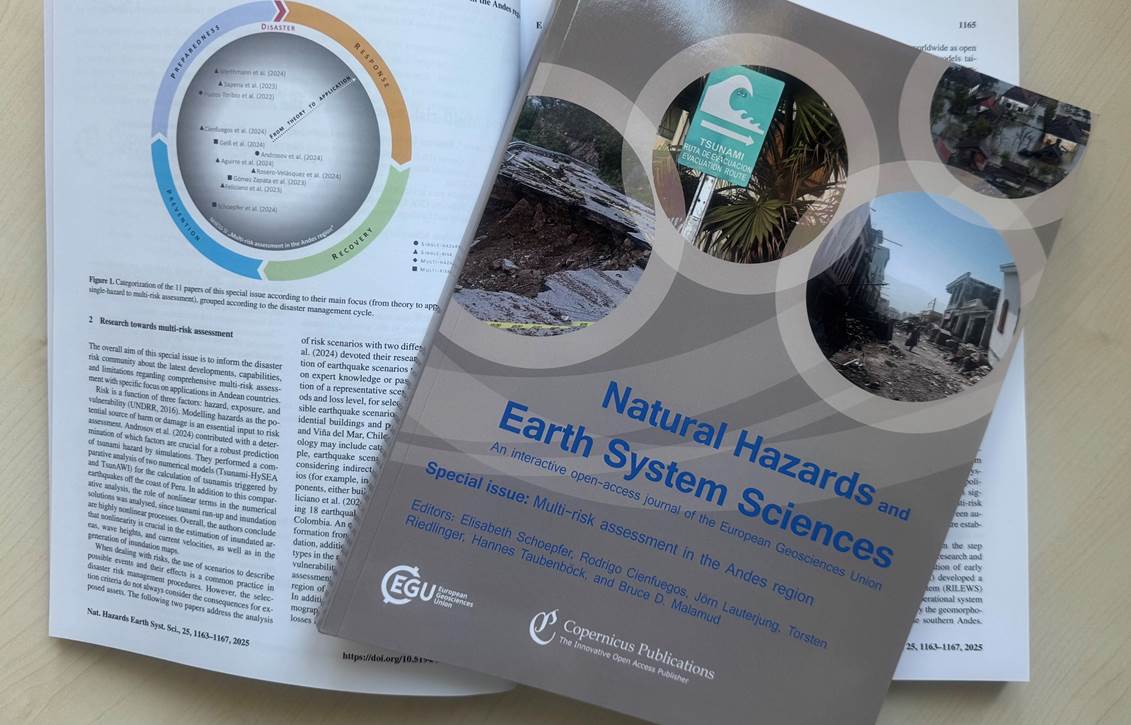

The Special Issue titled “Multi-risk assessment in the Andes region” in the journal “Natural Hazards and Earth System Sciences” (we had reported on this: https://remote-sensing.org/special-issue-in-natural-hazards-and-earth-system-sciences-published/) has now been published in printed form.
This special issue aims at contributing to the growing research on risk assessment, starting from hazard-specific evaluations and moving towards complex hazard situations and multi-risk assessment. It features 11 research papers along the prevention and preparedness phases of the disaster management cycle.
The guest editor team of this special issue consisted of Elisabeth Schoepfer, Torsten Riedlinger and Hannes Taubenböck from the Earth Observation Center (EOC) of the German Aerospace Center (DLR) in Oberpfaffenhofen and our Earth Observation Research Cluster (EORC) of the University of Würzburg, and Rodrigo Cienfuegos from the Pontifical Catholic University of Chile, Jörn Lauterjung from GFZ Helmholtz Centre for Geosciences, and Bruce D. Malamud from the Institute of Hazard, Risk and Resilience (IHRR), Durham University.
All articles in this special issue can be downloaded free of charge from the journal’s website.
Related Links
- NHESS Special Issue: Multi-risk assessment in the Andes Region
- RIESGOS project website
- NHAZ Special Issue: Multimodal Characterization of Built and Natural Environments for Multi-Risk Assessment