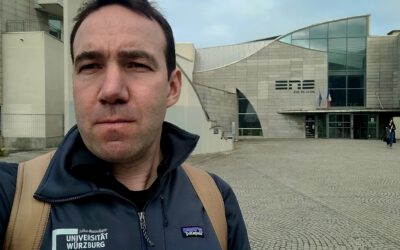
Recently, our team carried out another successful field campaign at the Schneefernerhaus research station on the Zugspitze in the Alps. Together with our EAGLE students, we collected UAS-based environmental data alongside detailed in-situ measurements of snow properties. These complementary datasets form the foundation for advancing our understanding of snow characteristics in high-alpine environments.
Thanks to a very well-organized and motivated team, we were able to make efficient use of a short weather window that offered suitable conditions for both UAS flights and fieldwork. Careful planning and coordination allowed us to safely acquire high-quality data despite the challenging alpine setting and limited time frame.
The collected data will now be further analysed within the Earth Observation for Cold Regions and Earth Observation for Alpine Regions courses. EAGLE students will work hands-on with the UAS sensor data, link it to spatially distributed in-situ measurements, and perform a range of analyses. These include LiDAR-based snow height estimation as well as thermal and multispectral investigations of snow properties. Through this process, students gain practical experience in integrating field observations with remote sensing techniques in complex mountain environments.