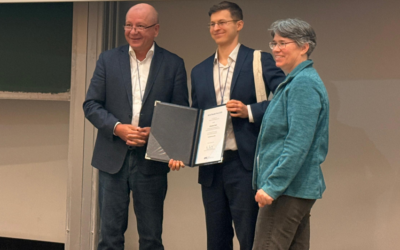


We are pleased to congratulate Agnes Zwick on the successful defense of her MSc thesis within the EAGLE programme. Her work, titled “New Housing Development Areas: Assessing Structural Types and Environmental Effects,” was carried out as part of the EO4CAM project (Earth Observation for Climate Adaptation and Mitigation) and makes a timely and policy-relevant contribution to a question that is increasingly pressing in Germany: how to reconcile the demand for new housing with land-saving and climate-adaptation goals.
While official statistics record construction activity at the level of individual buildings, there has so far been no publicly available dataset capturing where coherent new housing development areas (NHDAs) emerge, how large they are, and how they perform environmentally. Agnes addressed this gap by developing a spatially explicit and reproducible workflow to identify, characterise and evaluate NHDAs across Bavaria for the period 2015–2024/25. Newly built residential buildings were detected from changes in regularly updated 3D building models, aggregated into spatially coherent development areas, and described in terms of urban morphology and dominant building type. Construction start years were estimated using a random forest classifier trained on multi-year Sentinel-2 NDVI time series.
A key strength of the study lies in its comparative design. For each of the 839 identified NHDAs, a spatially corresponding reference area within the existing urban fabric was defined, allowing development-related environmental change to be separated from background variability. Environmental conditions were represented by Land Surface Temperature (LST) and NDVI, and the relationship between morphological differences and environmental outcomes was quantified using Gaussian linear mixed-effects models. An exploratory structural causal model complemented the analysis by examining potential pathway-specific associations.
The results offer valuable insights for planning and housing policy. New developments in Bavaria are predominantly built on former agricultural land and are less densely built and populated than their reference areas, accommodating on average 36% fewer residents per hectare. They remain measurably less green even ten years after construction began, while differences in LST narrow over time and become statistically indistinguishable after roughly a decade, a pattern likely shaped by the agricultural surroundings of many sites. Notably, a higher share of multi-family housing is associated with greater relative greenness, suggesting that compact development need not come at the expense of vegetation. The finding that environmental outcomes vary systematically with the surrounding degree of urbanisation underlines the value of state-wide analyses and spatially matched reference areas over isolated case studies.
Supervised by Dr. John Friesen and Prof. Dr. Hannes Taubenböck, the thesis reflects the interdisciplinary and application-oriented spirit of both the EAGLE programme and the EO4CAM project, bringing together remote sensing, geospatial data science and urban planning to address a real-world societal challenge. We are especially happy that Agnes will continue her research as a PhD candidate within EO4CAM, building on the foundations laid in her thesis.
We congratulate Agnes on this achievement and look forward to her future contributions to Earth observation research for climate adaptation and mitigation.