

Marcoecology meeting 2019 organized jointly with Remote Sensers

Marcoecology meeting 2019 organized jointly with Remote Sensers

October 10, 2018

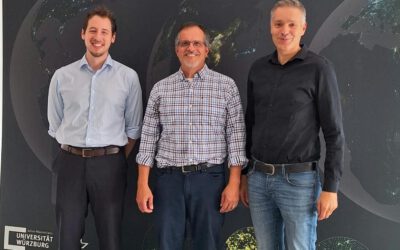
Staff of the Department of Remote Sensing are co-organizing the next Macroecology 2019 meeting as well as giving keynotes, namely Martin Wegmann and Hannes Taubenboeck, respectively. We are very happy to see remote sensing becoming an important topic in ecological research and that these two community increasingly collaborate especially within the University of Würzburg.

The Macroecology 2019 meeting will be the 13th annual meeting of the specialist group Macroecology of the Ecological Society of Germany, Austria, and Switzerland (GfÖ). The Specialist Group on Macroecology of the GfÖ is one of the leading scientific platforms for macroecological topics in central Europe. With the topic ‚Bridging local patterns and global challenges‘, we invite contributions ranging from ‘small data’ to questions of global relevance for biodiversity research. Hence, Macroecology 2019 aims to foster the dialogue between empiricists dealing with local patterns, bioinformaticians, data scientists, theoreticians and modellers from central Europe and beyond, promoting scientific exchange and progress.

The Macroecology 2019 will be held at the Biocenter  of the University of Würzburg, which is located in the Hubland campus. The historical city of Würzburg is located at the Romantic route of Bavaria, offering an attractive scenario for scientific exchange. In the registration day, participants will have the opportunity to attend a public opening keynote at the Toskana seminar room of the Residence Palace (an UNESCO heritage site), followed by an icebreaker at the wine cellar of the Staatlicher Hofkeller, also at the Residence Palace.

read more here: https://www.biozentrum.uni-wuerzburg.de/cctb/research/ecosystem-modeling/events/macroecology-2019/

follow us and share it on:

you may also like:

When Snow Disappears Too Early

When Snow Disappears Too Early

Fieldwork during the winter season in Svalbard usually comes with a built-in advantage: snow. It acts as a natural transport layer, making it possible to move efficiently across large distances with snowmobiles and sleds. You plan your campaign around that mobility:...

Advancing Agriculture with UAS Multi-Sensor Research

Advancing Agriculture with UAS Multi-Sensor Research

Understanding how agriculture can adapt to a changing climate is one of the key challenges of our time. At EORC, we are pleased to share that our researchers are currently collaborating with the Bavarian State Research Center for Agriculture (LfL) on an innovative...

New roll-up shows Urban Collaboration and Research

New roll-up shows Urban Collaboration and Research

Remote sensing thrives on collaboration as shown (by a few selected ones) on our most recent roll-up. Many of today’s most pressing urban and environmental challenges—rapid urbanization, climate change, landcover change, migration, inequality, and economic...

Hackathon within the Super-Test-Site Project

Hackathon within the Super-Test-Site Project

What happens when researchers and developers sit down together to explore a multidisciplinary urban dataset? Our researchers from the EORC joined a hackathon that took place within the Super-Test-Site Project, organised by Prof. Dr. Gunther Gust from the Chair of...

Field Days in the Oberpfalz: Exploring FSME Hotspots

Field Days in the Oberpfalz: Exploring FSME Hotspots

On April 17th and 29th our researchers Sofía and Ariane had two field days in the areas around Amberg and Schwandorf, one of Germany's most well-known TBE (tick-borne encephalitis) risk regions. They joined Prof. Dr. Gerhard Dobler and Dr. Lidia Chitimia-Dobler from...

Share This