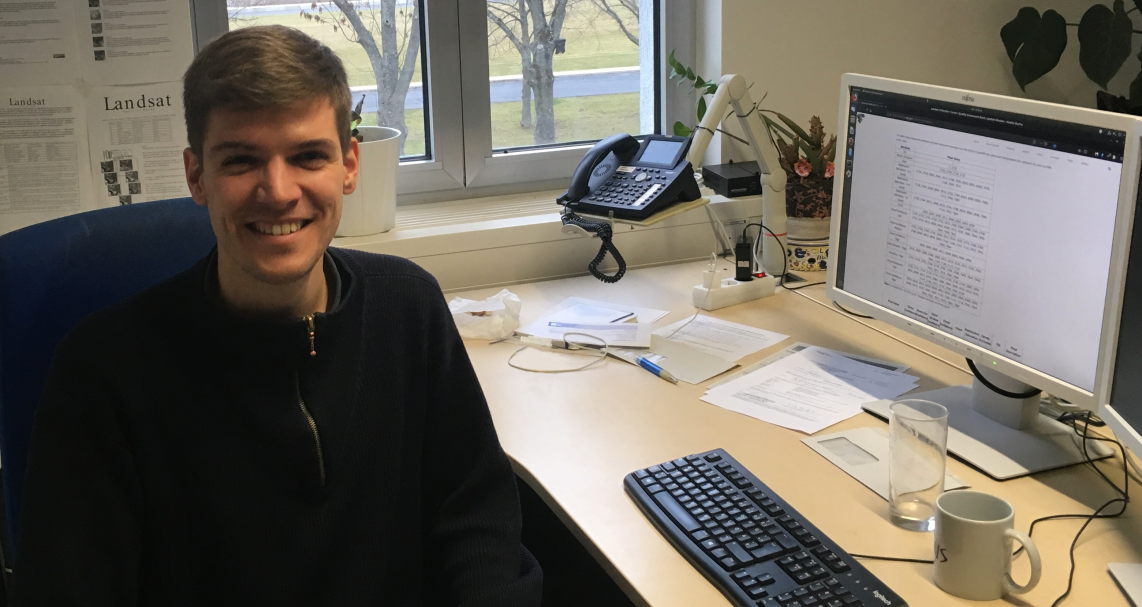

This month, Jakob Schwalb-Willmann joined the Department of Remote Sensing as a PhD student. He is investigating the potential of animal-environment interactions for remote-sensing-driven environmental research. In this context, he is interested in the utilization of machine learning to integrate movement tracking and remote sensing data for geonalytical applications, including the detection of phenological events, environmental changes or disruptions in animal-environment interactions.
Jakob has been studying the department’s EAGLE Master program from 2016 to 2018, specializing in Earth Observation and Geoanalysis. He finished his studies with his Master Thesis on the use of animal movement data for environmental research, titled “A deep learning movement prediction framework for identifying anomalies in animal-environment interactions”. During his Master studies, he worked as a student research assistant at the department. To gain knowledge on animal movement analysis and the overlaps between Geoanalysis and Movement Ecology, he visited the Max Planck Institute for Ornithology as an intern. He spent one semester at EURAC research in Bolzano, Italy, where he contributed in the development of an alpine-wide forest change detection system.
From 2013 to 2016, he studied Geography and Sociology (B.Sc.) at the Ludwig-Maximilians-University of Munich and joined the German Remote Sensing Data Center (DFD) at the German Aerospace Center (DLR) in the context of his Bachelor Thesis research on calculating broadband surface albedo from narrowband sensor data.