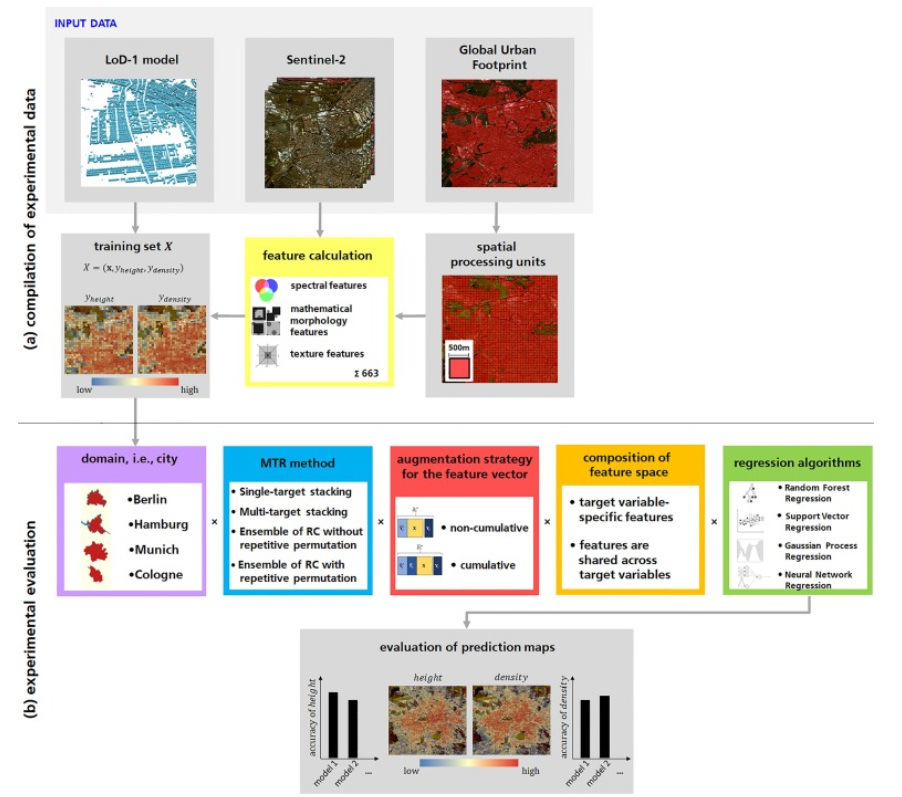

A new publication by our PhD students and PDs in International Journal of Applied Earth Observation and Geoinformation about “Multi-target regressor chains with repetitive permutation scheme for characterization of built environments with remote sensing” is available online. From the abstract: “Multi-task learning techniques allow the beneficial joint estimation of multiple target variables. Here, we propose a novel multi-task regression (MTR) method called ensemble of regressor chains with repetitive permutation scheme. It belongs to the family of problem transformation-based MTR methods which foresee the creation of an individual model per target variable. Subsequently, the combination of the separate models allows obtaining an overall prediction. Our method builds upon the concept of so-called ensemble of regressor chains which align single-target models along a flexible permutation, i.e., chain. However, in order to particularly address situations with a small number of target variables, we equip ensemble of regressor chains with a repetitive permutation scheme. Thereby, estimates of the target variables are cascaded to subsequent models as additional features when learning along a chain, whereby one target variable can occupy multiple elements of the chain. We provide experimental evaluation of the method by jointly estimating built-up height and built-up density based on features derived from Sentinel-2 data for the four largest cities in Germany in a comparative setup. We also consider single-target stacking, multi-target stacking, and ensemble of regressor chains without repetitive permutation. Empirical results underline the beneficial performance properties of MTR methods. Our ensemble of regressor chain with repetitive permutation scheme approach achieved most frequently the highest accuracies compared to the other MTR methods, whereby mean improvements across the experiments of 14.5% compared to initial single-target models could be achieved.”
read the full article at https://www.sciencedirect.com/science/article/pii/S0303243421003640?via%3Dihub