
Our PhD students Ines Standfuß published another article of your research “Time series enable the characterization of small-scale vegetation dynamics that influence fine-scale animal behavior – an example from white storks’ foraging behavior.” More details in from abstract below.
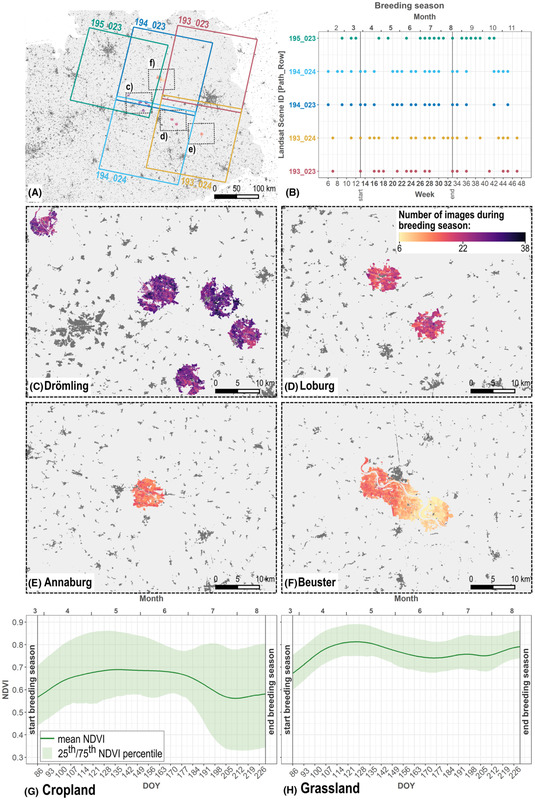
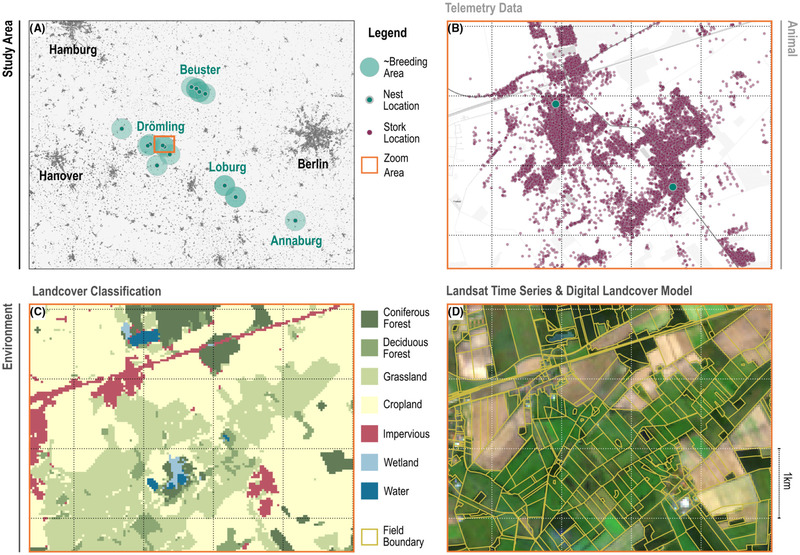
from the abstract: “Agricultural activities and vegetation growth cause rapid small-scale vegetation changes which dynamically alter habitat suitability. Time series enable to track down such variations of vegetation structure and are promising to examine their impact on animals’ life. Nevertheless, their potential to characterize vegetation dynamics in ways pertinent to animals’ fine-scale habitat use has not been adequately explored and ecologically meaningful proxies are lacking. To address this gap, we exemplary investigated foraging activities of breeding white storks in an agricultural landscape. Reflecting on the understanding that storks require short vegetation to access prey, we examined if good foraging conditions – early growth and post-harvest/mowing periods – are detectable using the points between local minima/maxima in NDVI profiles (half-maximum). We processed 1 year of Landsat imagery to identify half-maximum periods (HM: good prey access) and non-half-maximum periods (non-HM: poor prey access) on field-scale in croplands and grasslands. Additionally, we mapped used/unused fields and retrieved foraging duration/daily visitation rates from GPS tracks of the storks. We then explored habitat use, compared habitat use with habitat availability and tested temporal predictors distinguishing between HM/non-HM in habitat selection models. Examining habitat use, storks revisited croplands and grasslands significantly more often during HM than during non-HM, while foraging duration was only prolonged in croplands during HM. However, comparing habitat use with habitat availability, we observed that storks used croplands and grasslands in significantly higher proportions during HM than during non-HM. Additionally, we found that temporal information affected storks’ habitat selection and improved model performance. Our findings emphasize that the half-maximum proxy enables to coarsely distinguish temporal resource variations in storks’ foraging habitats, highlighting the potential of time series for characterizing behaviorally-relevant vegetation dynamics. Such information helps to create more species-centered landscape scenarios in habitat models, allowing to unravel effects of small-scale environmental changes on wildlife to ultimately guide conservation and management.”
read the full article: https://zslpublications.onlinelibrary.wiley.com/doi/10.1002/rse2.251