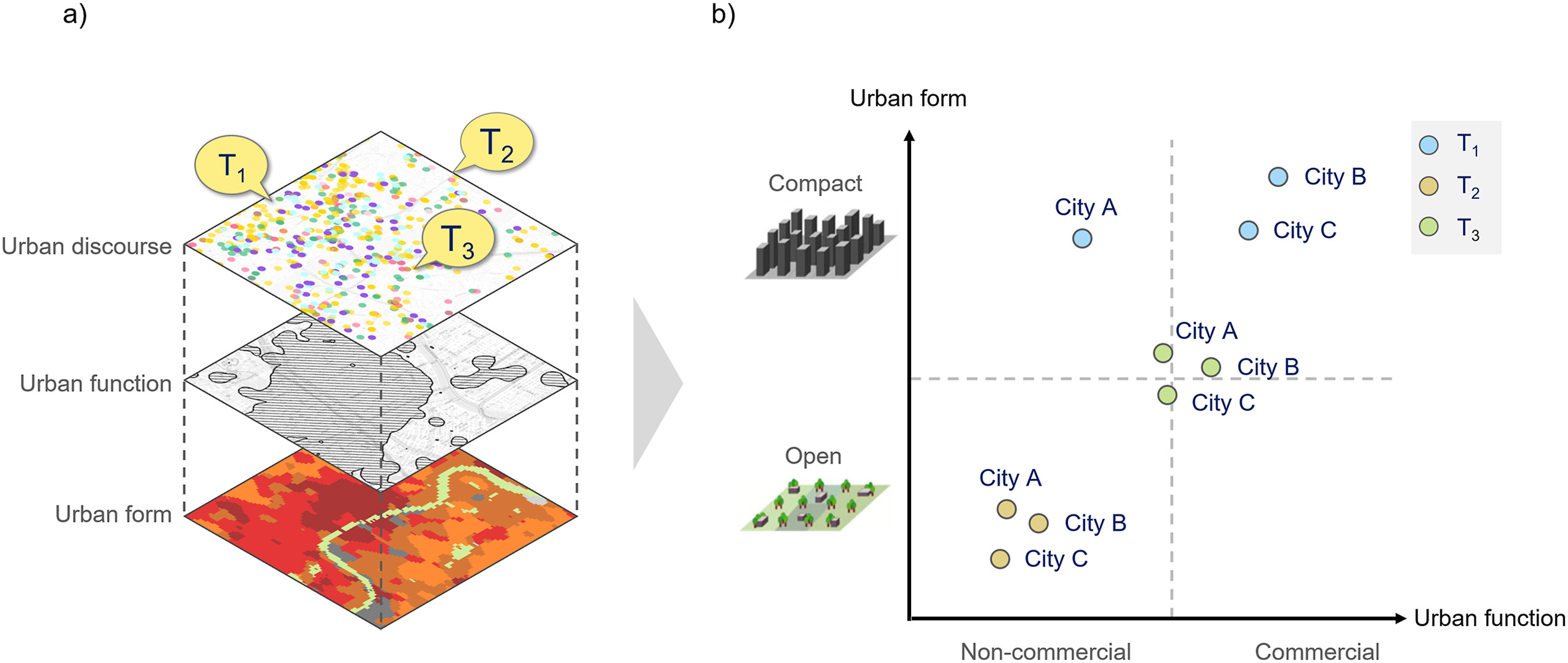

It is known that urban form and function are closely related. Beyond this, in a new study, empirical proof reveals how urban form and function are associated with urban discourse. In the new publication titled “Are urban form and function related to urban discourse? Insights from remote sensing and social media data for 15 major cities across the globe“, topic modeling was used to identify topics discussed in these cities using multilingual geolocated Twitter data. The remote sensing-based Local Climate Zones classification was used to represent urban form, and these datasets were integrated within a unified analytical framework. This research was a joint undertaking by researchers from our Earth Observation Research Cluster (EORC), the Geolingual Studies Team and the Department of English and American Studies of the University of Würzburg in Germany, the Yale University, in New Haven, USA, and the Earth Observation Center (EOC) of the German Aerospace Center (DLR). The study was just published in the Journal ‘Habitat International’ by De-Cyuan Jheng, Richard Lemoine-Rodríguez, Carolin Biewer, Karen C. Seto, and Hannes Taubenböck.
Here is the abstract of the paper: Urban form and function are closely related to people’s everyday lives. Understanding this relationship is essential for urban land-use planning. However, the variation of this relationship across cities has not yet been examined comprehensively at a global scale. This study investigates how urban form and function are associated with urban discourse across 15 major cities worldwide. We applied topic modeling to identify topics discussed in these cities using multilingual Twitter data. We utilized the remote sensing-based Local Climate Zones classification to represent urban form, applied spatial analysis to identify intra-urban areas with commercial function, and integrated these datasets within a unified analytical framework. Our results empirically reveal that urban discourse on Twitter is associated with urban form and function. For example, finance-related topics were more prevalent in compact urban forms with commercial function, whereas sports-related topics were more common in low-rise, non-commercial areas. However, this association is not consistent across all cities. Clear cross-city variation emerges, and topic concentrations can be grouped into three patterns: cross-regional, regionally distinct, and urban-form-independent. For instance, topics classified as “Food & Drinks”, “Real Estate”, and “Art” tend to follow the regionally distinct pattern. These patterns indicate that everyday activities and discourses among urban dwellers vary systematically across urban contexts rather than following a universal pattern. This analysis demonstrates an interwoven relationship between urban form, urban function, and urban discourse, providing insights into the social dimension of cities and informing spatial planning.
Read the full article here: https://www.sciencedirect.com/science/article/pii/S0197397526002006
This work is closely related to previous studies in the fields of Global Urbanization and Geolingual Studies – see here for more information:
On global urbanization:
On Geolingual studies: