
A Successful Day in the Field: Grassland Sampling in the Bavarian Rhön

A Successful Day in the Field: Grassland Sampling in the Bavarian Rhön

September 9, 2025

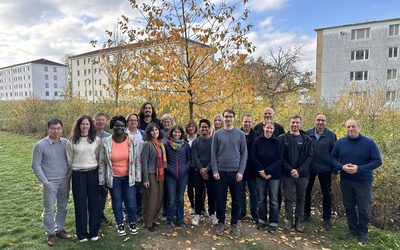
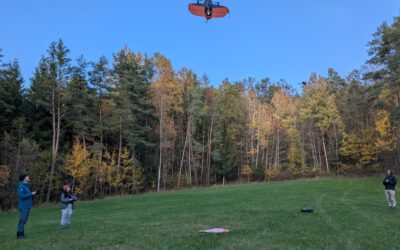
On August 21st, the EO4CAM project team embarked on a successful field campaign in the surroundings of Bad Neustadt an der Saale, the district capital of Rhön-Grabfeld in Lower Franconia. The Bavarian Rhön serves as a pilot region within EO4CAM, providing a rich experimental landscape for in-depth studies, such as detailed investigations of grasslands.

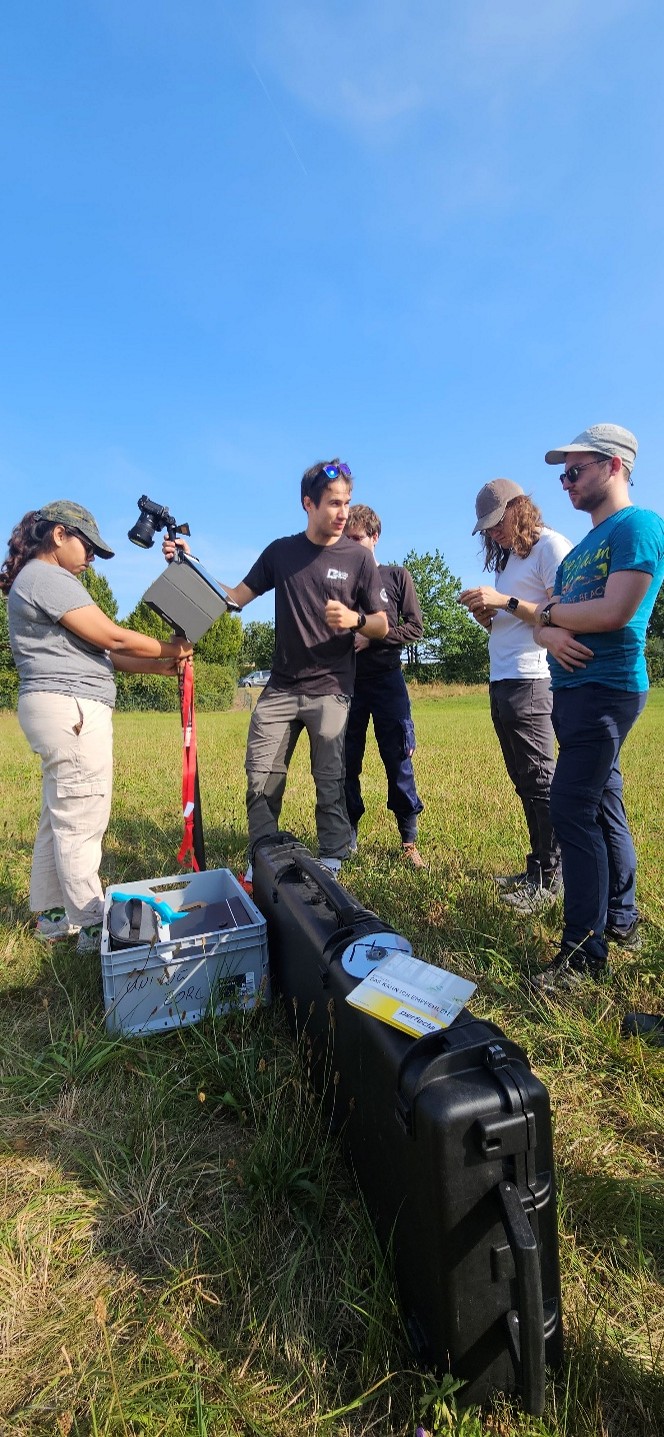
The field day focused on a comprehensive and standardized sampling of grassland areas, aiming to collect high-quality data on several key parameters: grassland height, above-ground biomass, Leaf Area Index (LAI), canopy cover, and cover fraction. These measurements are essential for the calibration and validation of Earth observation-based grassland datasets that are developed within EO4CAM.

The fieldwork was conducted by EO4CAM staff from the DLR and the EORC and enthusiastically supported by students from the international EAGLE Master’s program. Their participation not only contributed to the success of the campaign but also provided valuable hands-on training in field methods and the use of state-of-the-art measurement instruments.

The students will further process and present the findings from the field day as part of the seminar ‘Field Methods’, deepening their understanding of grassland dynamics and remote sensing applications. This integration of research and education exemplifies EO4CAM’s commitment to fostering the next generation of environmental scientists.

Thanks to the friendly support of local landowners and stakeholders, the team was able to access and sample a diverse range of grassland plots. The collaboration ensured smooth logistics and enriched the campaign with local insights.

 

follow us and share it on:

you may also like:

Würzburger Förderpreis awarded to our URBAN:Pulse project

Würzburger Förderpreis awarded to our URBAN:Pulse project

“A remote sensing scientist, a social geographer, an informatics researcher, a sports researcher, a psychologist, a linguist and an economist meet ... what sounds like the start of a joke, was the start of a great interdisciplinary research project.” That’s how Hannes...

Annual Meeting of the NetCDA consortium

Annual Meeting of the NetCDA consortium

On November 3-4, 2026, the NetCDA II (European Academic Network for Capacity Development in Climate Change Adaptions in Africa) project network of 12 German academic partners met at the EORC for their annual meeting. We welcomed our new German research institutions on...

Mainpost reported on Stefan Dech’s Bavarian State Medal

Mainpost reported on Stefan Dech’s Bavarian State Medal

We’re happy to see that Mainpost, our local newspaper, also reported on the Bavarian State Medal for Outstanding Services to the Environment. Stefan Dech received it on October 21 at the Munich Residenz, and Environment Minister Thorsten Glauber gave the laudatory...

UrbanPulse in the Mainpost, and invitation to the festivities

UrbanPulse in the Mainpost, and invitation to the festivities

If you open the printed Mainpost today, keep an eye out for the Universitätsbund Würzburg’s invitation to the Festkonzert. Among the topics on the page, there’s one we’re rather proud of: our newly funded project URBAN:Pulse, which will be officially celebrated at the...

Field work for MONID-HABITRACK project

Field work for MONID-HABITRACK project

Today our researchers from the department working on the MONID-HABITRACK project, that is funded by the BMFTR, went to the field to acquire LiDAR, thermal and multispectral data with their drones. Within our department the project is located at the Chair of Remote...

bzgl. Art. 50 Verordnung (EU) 2024/1689 (AI Act):

Überwiegend werden eigene originäre Texte und Bilder des EORC genutzt, jedoch sind einige Inhalte von blog post Texten teilweise mit Hilfe von KI überarbeitet worden und einige Bilder sind ganz mit KI erstellt, die jedoch deutlich keine photorealistische Darstellungen abbilden. Aussnahmen sind KI generierte fernerkundliche Datensätze, die explizit für Forschungszwecke mit KI erstellt wurden, hier wird aber durch den assoziierten Text der wissenschaftliche Grund der KI generierten Bilder erläutert.

Share This