
A Successful EO4CAM Project Meeting in Würzburg: Strengthening Collaboration for Earth Observation Research for Climate Adaptation in Bavaria

A Successful EO4CAM Project Meeting in Würzburg: Strengthening Collaboration for Earth Observation Research for Climate Adaptation in Bavaria

November 24, 2025

On Thursday, 20 November, more than 30 experts from the Earth Observation Research Cluster (EORC) at the University of Würzburg and the Earth Observation Center (EOC) at the German Aerospace Center (DLR) in Oberpfaffenhofen gathered at the EORC for a full-day internal EO4CAM project meeting. The event brought together senior researchers and young scientists, as well as new team members, including several doctoral candidates who recently joined the project.

The meeting focused not only on reviewing the project’s progress so far but also on discussing current research activities and shaping the roadmap for future work. The agenda included thematic sessions on ongoing remote sensing analyses and the data portal, updates on methodological advances, and plans for upcoming user workshops – an essential component to ensure that project results will effectively support decision-making in climate adaptation across Bavaria.

Beyond scientific presentations, the gathering served as an opportunity to strengthen professional exchange and foster closer connections within the expanding project team. A welcoming atmosphere and informal conversations helped create a collaborative environment that encouraged new ideas and interdisciplinary perspectives.

Overall, the EO4CAM project meeting was an outstanding success. It showcased the project’s growing momentum, reaffirmed the strong partnership between EORC and EOC, and laid a solid foundation for the next phase of research and user engagement. The team left the meeting energized and aligned – ready to continue advancing remote sensing–based insights for climate adaptation.



follow us and share it on:

you may also like:

Successful MSc Defense by Christina Krause

Successful MSc Defense by Christina Krause

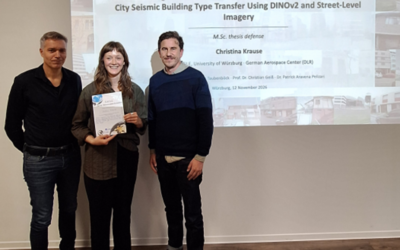
Congratulations to our EAGLE student Christina Krause, who successfully defended her MSc thesis titled "Active Learning and Parameter-Efficient Feature Adaptation for Cross-City Seismic Building Type Transfer Using DINOv2 and Street-Level Imagery" on November 12,...

Successful MSc Defense by Marlene Bauer

Successful MSc Defense by Marlene Bauer

Congratulations to our EAGLE student Marlene Bauer, who successfully defended her MSc thesis titled "Robust and Uncertainty-Aware Informal Settlement Mapping – Cross-City Generalisation Across Diverse Urban Morphologies Using High-Resolution Satellite Imagery in...

Help Us Understand Ticks: Join the MONID HABITRACK Study

Help Us Understand Ticks: Join the MONID HABITRACK Study

Lyme borreliosis and tick-borne encephalitis (TBE) are the most common tick-borne diseases in Germany, and they are becoming more relevant. Many infections go unnoticed because they cause mild symptoms or none at all. The MONID HABITRACK project, funded by the BMFTR,...

Setting Up for the 2nd EO4CAM Nutzerworkshop

Setting Up for the 2nd EO4CAM Nutzerworkshop

Right now our staff are busy hauling cases, mounting displays and testing every cable for the 2nd EO4CAM Nutzerworkshop, “Erdbeobachtung für die Klimaanpassung, behördliche Akteure in Bayern”. The doors open tomorrow, and the exhibition...

A dashboard for multi-UAS thermal data

A dashboard for multi-UAS thermal data

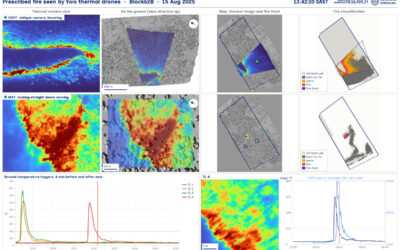
Mapping an active fire with various drones flying in parallel is hard enough. But getting the data processed, evaluated and turned into research datasets is a different story. The publication is on its way, and for now we’d like to share a dashboard by Antonio José...

bzgl. Art. 50 Verordnung (EU) 2024/1689 (AI Act):

Überwiegend werden eigene originäre Texte und Bilder des EORC genutzt, jedoch sind einige Inhalte von blog post Texten teilweise mit Hilfe von KI überarbeitet worden und einige Bilder sind ganz mit KI erstellt, die jedoch deutlich keine photorealistische Darstellungen abbilden. Aussnahmen sind KI generierte fernerkundliche Datensätze, die explizit für Forschungszwecke mit KI erstellt wurden, hier wird aber durch den assoziierten Text der wissenschaftliche Grund der KI generierten Bilder erläutert.

Share This