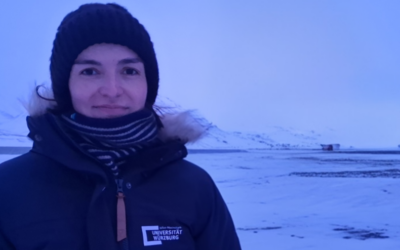

At the Earth Observation Research Cluster (EORC), our researchers are tackling some of today’s most pressing environmental and societal challenges using cutting-edge remote sensing and data science. In this edition, we highlight Andrea Sofía García de León, whose work bridges urban ecology, machine learning, and environmental inequality.
From Guatemala to Würzburg: A global journey into Earth observation
Andrea Sofía García de León began her academic journey with a background in environmental engineering at the University of San Carlos in Guatemala. Her early experience already reflected a strong connection between environmental processes and applied geospatial analysis, including work with international organizations such as the World Bank and national environmental institutions.
She later joined the EAGLE MSc program at the Julius-Maximilians-University of Würzburg, where she specialized in applied Earth observation and geoanalysis. Since 2022, she has continued there as a doctoral researcher, contributing to the research environment of EORC.
Research focus: Urban green and remote sensing
Sofia’s research sits at the intersection of urban ecosystems and remote sensing. She is particularly interested in how urban green spaces and even individual trees can be mapped and analyzed at scale using Earth observation data.
Her work leverages high-resolution satellite imagery and machine learning techniques to extract detailed information about urban environments. This includes identifying tree species, estimating ecosystem services, and understanding how green infrastructure is distributed across cities.
One of her recent studies demonstrates how multi-temporal satellite data and advanced classification approaches can be used to map over 160,000 individual trees in an urban area, achieving high classification accuracies and enabling improved ecosystem service assessments.
Linking environment and society
A distinctive aspect of Sofia’s work is its strong societal dimension. She contributes to interdisciplinary projects that connect environmental data with socio-economic indicators. For example, she has worked on modeling spatio-temporal patterns of poverty using satellite-based nighttime light data combined with additional datasets such as electricity consumption. This research highlights how Earth observation can support a better understanding of inequalities in regions where traditional data may be limited.
Urban climate and ecosystem services
Sofia is also actively involved in her PhD research on urban climate and ecosystem services, particularly the role of vegetation in regulating urban temperatures.
In collaboration with partners including the Technical University of Munich and the German Aerospace Center (DLR), she has applied remote sensing techniques to analyze land surface temperature variations across different land-use and vegetation conditions. These studies contribute to a better understanding of how urban forests mitigate heat stress and improve living conditions in cities.
International collaboration and scientific exchange
Sofia regularly presents her work at international conferences, engaging with the global research community. At the IUFRO World Congress, she showcased her work on remote sensing-based tree species classification, contributing to discussions on sustainable urban forests and ecosystem services.
These experiences not only strengthen scientific exchange but also foster collaborations across disciplines and regions—an essential component of modern Earth observation research.
Looking ahead
With a strong foundation in remote sensing, machine learning, and environmental science, Andrea Sofía García de León is contributing to a more nuanced understanding of how urban environments function—and how they can be made more sustainable and equitable.
Her work exemplifies the EORC mission: combining innovative Earth observation methods with real-world applications that address both environmental and societal challenges.