
On July 08, 2025, Sharmin Mim will defend her master thesis on “Ability of Random Forest Model to Predict the Mean and Standard Deviation of Winter Wheats Biomass in Bavaria: A case study ” at 13:00 in seminar room 3, John-Skilton-Str. 4a.
From the abstract:
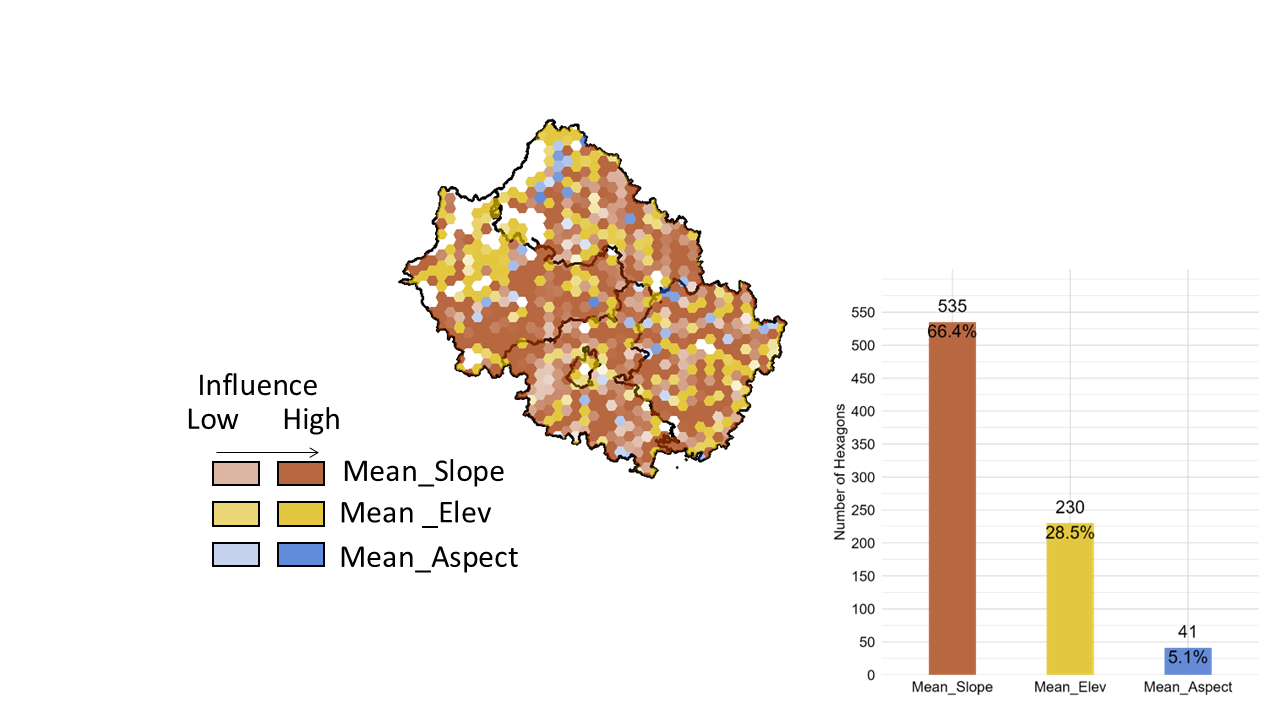
Accurate biomass estimation is essential for improving yield estimation and supports agricultural resource management and sustainable agricultural planning under environmental variability. This study estimates Winter Wheat (WW) biomass responses in the Rhön region, Bavaria, using Light Use Efficiency (LUE) modelled biomass and a 5 km² hexagon-based bio-spatial framework. A Random Forest (RF) model was employed to predict the multi-annual (2001-2019) mean and standard deviation (SD) of biomass using multi-source biophysical variables, including spatial topographic, soil, landscape diversity metrics, spatio-temporal Climate ( 2001-2019), and LUE modelled biomass (2001-2019). The study integrated mean and SD of Spatial predictors- elevation, slope, aspect, soil potential, soil bulk density, sand, silt, clay, cation exchange, Shannon Diversity Index (SHDI), small woody features ( SWF), Spatio-temporal predictors temperature, precipitation, solar radiation, and LUE modelled biomass. Model performance was validated using the cross-validation method on the available internal validation dataset and district-wise assessments. The RF model showed better accuracy in predicting SD biomass with an R² = 0.70, in contrast to the mean biomass R² = 0.36, demonstrating its ability to capture variability better. Model explanation using variable importance analysis, SHap additive exPlanations (SHAP) analysis, and Partial Dependence Plots (PDPs) analysis elucidated that mean biomass is mainly driven by landscape diversity and soil physical properties, while topography and soil have a major influence on shaping biomass variability. SHAP analysis revealed the spatial variation of variable influence in the Rhön region: soil bulk density, elevation, and SWF are key drivers of biomass variability in Bad Kissingen; Haßberge is more influenced by SHDI, SWF, slope, and precipitation; soil bulk density, slope and elevation shape the biomass variability in Rhön Grabfeld.; temperature, soil bulk density, slope, and SWF are crucial factors to drive biomass variability in Schweinfurt. The PDPs analysis illustrated threshold effects of predictors, for instance, biomass was higher at (≤17°C) range and declined between 18 °C and 20 °C. Similar to temperature elevation also showed threshold impact, biomass increases at elevation values of ≤ 480 m.a.s.l. This depicts that there is an optimum condition of the environment for crop growth. Correlation heatmap analysis unearths the soil climate compound effect to modulate the crop growth and the soil’s capacity to mediate or enhance the climate variabilities’ impact on crop growth. This makes soil a crucial element of an agricultural adaptation plan. The study gives a scalable bio-spatial framework by integrating the mechanistic process of the LUE model for crop growth and the RF model’s capacity to capture non-linear complex interaction effects of predictors. In addition, this study highlights the effectiveness of ecological metrics like SHDI integration with machine learning methods. The study findings might be useful for farmers and policymakers to understand the region and local specific variation and context of crop growth, and support sustainable local resource and agricultural planning.
1st Supervisor: Dr. Maninder Singh Dhillon
2nd Supervisor: Dr. Michael Thiel