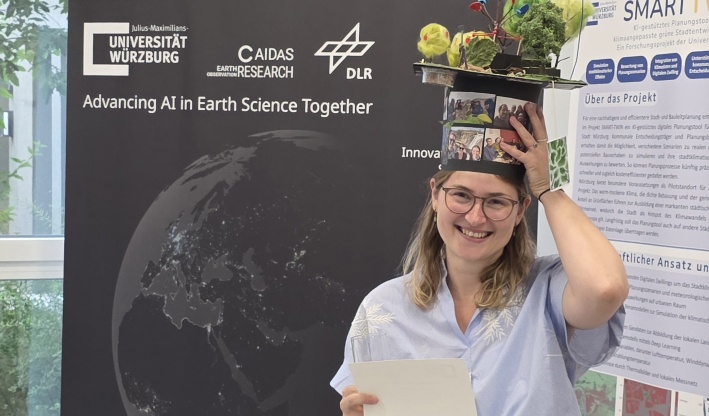

We are pleased to congratulate Julia Rieder on the successful defense of her PhD thesis!
Over the past years, Julia has investigated how European beech forests respond to severe drought events and which factors determine whether individual trees survive or die under increasing environmental stress. Her work combined detailed field observations with advanced Earth observation methods, particularly LiDAR-based analyses, to better understand the interplay between tree characteristics, competition, soil conditions, and drought impacts.
In her dissertation, Julia studied more than 500 mature beech trees across northern Bavaria that were affected by the exceptional drought years of 2018 and 2019. By integrating field measurements with three-dimensional forest structure information derived from airborne laser scanning, she was able to identify key drivers of drought-induced tree mortality and resilience. Her results provide valuable insights into the mechanisms shaping forest responses to climate change and contribute to improving future forest monitoring and management strategies.
A particular strength of Julia’s work is the successful combination of ecological field research and remote sensing. Throughout her PhD, she developed and applied innovative methods for analysing forest structure and tree competition, including the R package TreeCompR, which enables researchers to quantify neighbourhood competition from both traditional inventory data and 3D point clouds.
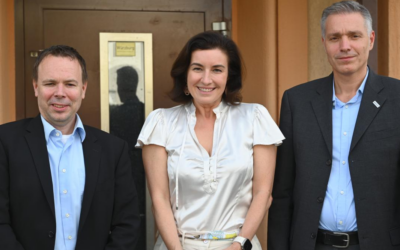
Julia conducted her doctoral research at the Earth Observation Research Cluster (EORC) under the supervision of Tobias Ullmann and Bernhard Schuldt. The examination committee was completed by Fabian Fassnacht and Christian Zang as external examiner. The interdisciplinary expertise of the committee reflects the strong connection between forest ecology and Earth observation that characterized Julia’s research throughout her PhD.
We congratulate Julia on an impressive dissertation and an excellent defense.
Congratulations, Dr. Julia Rieder!