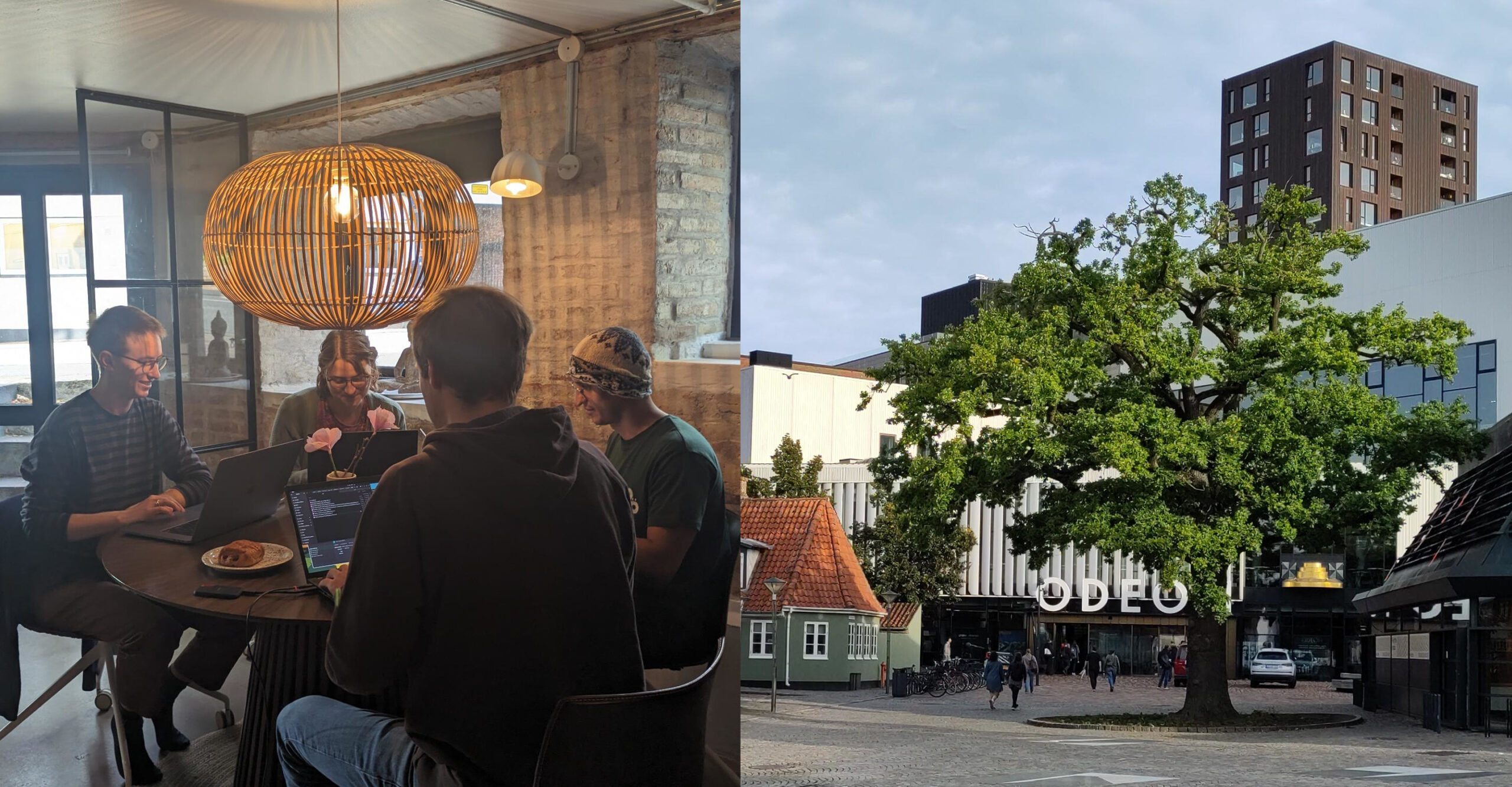

This week, the EORC is participating in the joint NSO-GfÖ 2026 conference in Odense, Denmark. The conference brings together researchers of all career stages from all across ecology research, representing a wide range of methods and applications, including topics at the intersection of remote sensing and ecology. The event is particularly unique, as it is jointly hosted by the Nordic Society Oikos (NSO), representing the ecological societies of Denmark, Finland, Iceland, Norway, and Sweden, and the Gesellschaft für Ökologie (GfÖ), representing Austria, Switzerland, and Germany.
Having arrived in Odense on Sunday after an enjoyable, zero-CO2-emissions trip using ICE and ECE trains from via Hamburg, we have been busy preparing for our presentations. Lucky to be jointly accommodated not far away from the conference center, we can spend the mornings working and planning the day ahead before heading over to ODEON, Odense’s conference house to attend sessions, network, and present our research.
Throughout the week, EORC researchers are contributing with four talks and one poster presentation, and are supporting the conference as session chairs and volunteers:
Dr. Maninder Singh Dhillon presents research developed as part of the EO4CAM project, titled “A Remote Sensing-Based Farmland Habitat Biodiversity Indicator for Bavaria: A Landscape Ecology Approach” in a session focused on biodiversity in agriculture landscapes. In addition, Maninder is co-chairing the session “Mapping and Modelling Ecological Change with Remote Sensing”.
Dr. Julia Rieder is speaking about an element of her PhD research in the context of the Beechdecline and EO4CAM projects, with a talk titled “Spatiotemporal Patterns of Canopy Openness and Their Link to Drought-Induced Defoliation in European Beech” as part of the session “Drought”.
Dr. Jakob Schwalb-Willmann is giving a talk on his research in the High Arctic, titled “Linking remote-sensing-derived snow onset timing and snow depth with vegetation phenology to assess reindeer foraging conditions in Svalbard”, a result of our close partnership with the University Centre in Svalbard (UNIS). In addition, Jakob is co-chairing the session “Arctic ecology”.
Elio Rauth is giving insights into his current PhD research in collaboration with UNIS with a talk titled “Linking Small-Scale Arctic Vegetation Composition to Snow Depth using UAS Data” as part of a session on Arctic and Alpine community ecology. Elio is supporting the conference as volunteer.
Antonio José Castañeda-Gómez is showing his current work in the field of UAV-based forest monitoring being part of his PhD studies with a poster titled “Characterizing forest structural complexity along silvicultural treatment gradients using UAS multisensor and multitemporal data in the University Forest Sailershausen, Germany”. Antonio is also helping as a volunteer.
It is great to have the opportunity to have been accepted to attend and present at the joint NSO-GfÖ 2026. We are thankful for the opportunity and the funding allowing us to do the trip.